


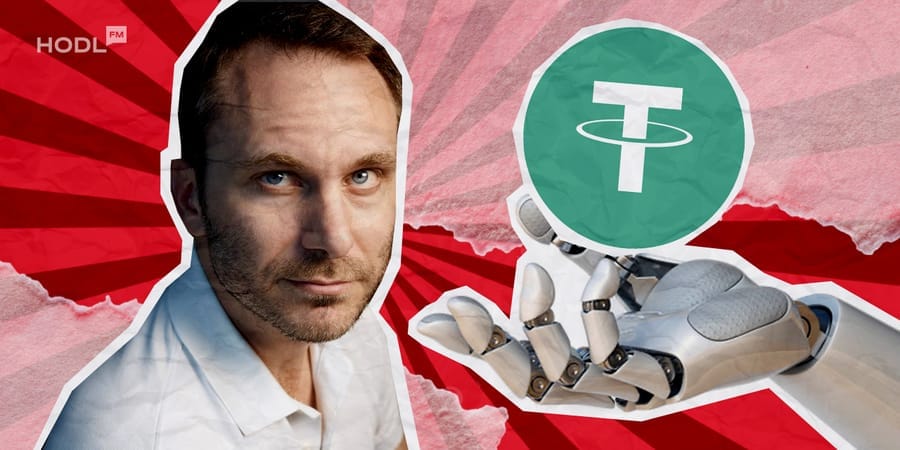



Tether chief executive Paolo Ardoino has cautioned that a potential bubble forming around artificial intelligence could pose a serious risk to Bitcoin markets by 2026. Speaking on the Bitcoin Capital podcast, co‑hosted by Bitfinex Securities and Blockstream, Ardoino said aggressive spending in AI infrastructure and data centers might lead to distortions in global equity markets that could spill over into the crypto sector.
He noted that Bitcoin remains more connected to traditional capital markets than many investors assume. “That is the so‑called AI bubble,” Ardoino said, referring to the surge in capital directed into AI‑linked ventures. He described massive investments in power generation and graphics processing units as unsustainable and cautioned that a shift in investor sentiment toward AI could rapidly deflate valuations.
Connection between Bitcoin and traditional markets
Ardoino explained that Bitcoin continues to mirror movements in US equities when risk appetite changes. If the AI enthusiasm fades, volatility across technology stocks could translate into pressure on Bitcoin prices. Although Bitcoin has often been branded as an uncorrelated asset, its response to broader market stress suggests a continuing relationship with traditional financial cycles.
In the event of cooling enthusiasm for AI by 2026, Ardoino expects that Bitcoin could experience secondary effects from a potential equity market sell‑off. He identified three overlapping factors: the influence of technology stock valuations, the flow of capital between assets, and investor behavior during episodes of uncertainty.
However, Ardoino said that Bitcoin’s maturing investor base now includes institutional and government buyers, which could limit the scale of any downturn.
“So I would imagine that sharp corrections of 80%, like we saw in 2022 or early 2018, might not be the case anymore,” he said.
Pension funds and long‑term holders, he added, have changed Bitcoin’s supply dynamics and provide a stabilizing influence.
AI speculation versus long‑term fundamentals
According to Ardoino, the central concern is not AI technology itself but the speculative boom surrounding it. The rapid expansion of AI companies, combined with large capital flows into infrastructure and energy projects, has inflated expectations that may not align with actual earnings capacity. A steep correction in these valuations could harm risk assets globally, including Bitcoin.
Paolo Ardoino said investor discipline would be tested if AI market optimism unwinds. Whether Bitcoin can maintain resilience depends on how investors interpret its role within increasingly institutionalized markets. The closer Bitcoin integrates with mainstream finance, the more sensitive it may become to policy and sentiment shifts.
Institutional adoption and tokenization outlook
Despite his warning about the AI bubble risk, Ardoino expressed confidence in Bitcoin’s long‑term outlook. He highlighted real‑world asset tokenization as one of the next growth areas for digital assets. Tokenized securities and commodities, he said, will likely become a significant part of the crypto industry’s expansion.
Ardoino linked this evolution to the growing participation of traditional financial institutions. As these entities bring operational expertise and regulatory certainty to blockchain applications, tokenized assets could reinforce rather than undermine Bitcoin’s position.
“Tokenized securities and commodities are going to be massive,” he said.
Yet he urged caution against letting institutional involvement dominate Bitcoin.
“Bitcoin is for Bitcoin, right? You don’t want 99% of Bitcoin being institutionalized.”
European regulation and treasury company concerns
The Tether CEO also offered a skeptical view of Europe’s regulatory landscape. “I’m very bearish on Europe,” Ardoino said, criticizing European policymakers for attempting to regulate technologies they do not yet fully understand. He argued that the European Union’s Markets in Crypto‑Assets Regulation (MiCA) framework could stifle innovation and drive talent elsewhere.
Tether has refused to align its USDT stablecoin with MiCA, a decision that has prompted many European crypto service providers to delist the token. Ardoino called this result an example of how strict oversight risks damaging competitiveness across the region.
He also cautioned against the rise of digital asset treasury (DAT) companies that rely entirely on holding crypto assets without building long-term business models.
“I think that you want a treasury company to have an amazing operational business,” he said.
As an example, he cited the Tether‑backed Bitcoin firm Twenty One, which combines a strong operational focus with a substantial Bitcoin treasury.
Bitcoin’s next phase
Tether’s CEO sees structural changes ahead for the crypto market. He expects steady institutional participation, wide adoption of real‑world asset tokenization, and fewer extreme swings in Bitcoin’s price cycles. Even so, the concentration of speculative capital around AI could create disruptions that test Bitcoin’s supposed independence from global equity markets.
Ardoino’s message offers a dual perspective: optimism about Bitcoin’s resilience and caution about external risks. For investors, that balance highlights the need to watch trends in both digital assets and technology markets as the 2026 horizon approaches.
 Tanya Petrusenko
Disclaimer: All materials on this site are for informational purposes only. None of the material should be interpreted as investment advice. Please note that despite the nature of much of the material created and hosted on this website, HODL FM is not a financial reference resource, and the opinions of authors and other contributors are their own and should not be taken as financial advice. If you require advice. HODL FM strongly recommends contacting a qualified industry professional.