






On November 30, Telegram founder Pavel Durov announced that Cocoon, a decentralized confidential compute network built on The Open Network (TON) blockchain, is now fully live and operational. The system, formally known as the Confidential Compute Open Network, aims to process artificial intelligence (AI) requests with full protection of user privacy and data confidentiality.
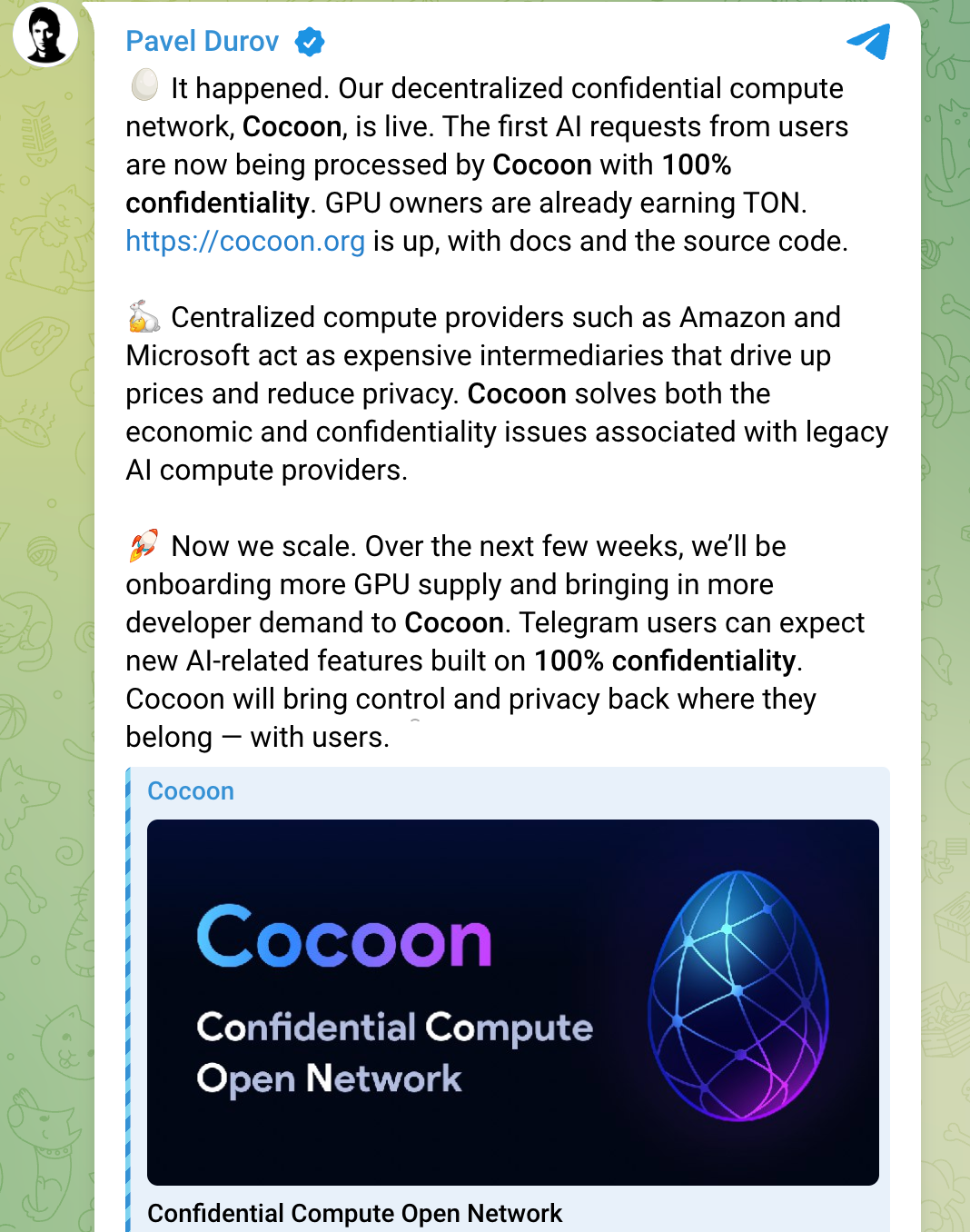
Durov confirmed the launch in a public post, writing that “our decentralized confidential compute network, Cocoon, is live. The first AI requests from users are now being processed by Cocoon with 100% confidentiality. GPU owners are already earning TON.” The official website for the project, cocoon.org, has also gone live with technical documentation and open-source code.
The Cocoon network integrates directly with Telegram and marks a key step in TON’s evolution as a core infrastructure layer for privacy-based AI applications. Telegram serves as the first major customer for the project and is expected to play a central role in driving its early adoption.
GPU owners earn crypto for confidential AI processing
Cocoon allows anyone who owns a graphics processing unit (GPU) to lease their computing resources and earn Toncoin (TON) tokens in return. Those GPUs process AI workloads such as text generation or image recognition tasks that require privacy. According to Durov, contributors are already providing computing power and receiving TON rewards through the platform.
The network matches these GPU providers with developers and applications that need to perform confidential AI tasks. Unlike traditional cloud systems, Cocoon ensures that GPU operators have no access to the data they handle. Users retain full privacy, while node operators receive financial incentives for contributing computational power.
This model establishes what Durov described as a “decentralized market for confidential AI processing” and removes reliance on centralized infrastructure controlled by large corporations. The system can scale quickly as more GPUs, including small miners and independent data centers, connect to the TON-based network.
Cocoon as an alternative to centralized AI providers
Cocoon operates as a trustless computation environment in which user inputs, models, and outputs remain private. The framework uses Trusted Execution Environments (TEEs), including Intel TDX, to ensure verifiable and secure model execution. Even though independent GPU operators power the network, they cannot read or alter the encrypted data passing through the system.
Durov has positioned Cocoon as an alternative to centralized providers. He stated that “centralized compute providers such as Amazon and Microsoft act as expensive intermediaries that drive up prices and reduce privacy. Cocoon solves both the economic and confidentiality issues associated with legacy AI compute providers.”
This approach supports Telegram’s ongoing emphasis on user sovereignty and data protection. AI requests generated within Telegram can route through Cocoon for processing, which ensures that private data never leaves the encrypted compute environment.
TON blockchain powers Telegram’s in-app AI economy
Cocoon’s deployment fits into Telegram’s broader TON-based economy. The TON blockchain already supports creator payouts, advertising payments, and microtransactions across Telegram’s interface. With Cocoon, TON also becomes the incentivization layer for decentralized AI compute.
As more GPU owners join the network and developers build AI applications that plug into Cocoon, TON could emerge as a unified digital economy integrating messaging, payments, and confidential artificial intelligence, all running inside a single blockchain ecosystem.
Durov said the project will continue scaling quickly.
“Over the next few weeks, we’ll be onboarding more GPU supply and bringing in more developer demand to Cocoon. Telegram users can expect new AI-related features built on 100% confidentiality,” he added.
A decentralized path forward for private AI
The debut of Cocoon aligns with a growing movement in technology toward privacy-preserving AI systems. Decentralized compute networks challenge the dominance of major tech providers, distributing control over data and computation to independent participants.
By combining blockchain transparency with confidential computing, Cocoon seeks to create an AI infrastructure that operates without intermediaries while maintaining secure execution guarantees. The project’s design ensures that even as computation scales across a global network of nodes, user trust remains rooted in cryptographic verification rather than corporate control.
With Telegram as its first customer and promoter, Cocoon has begun processing live AI tasks under full privacy conditions. Durov concluded his announcement by saying, “Cocoon will bring control and privacy back where they belong with users.”
 Roman Zaika
Disclaimer: All materials on this site are for informational purposes only. None of the material should be interpreted as investment advice. Please note that despite the nature of much of the material created and hosted on this website, HODL FM is not a financial reference resource, and the opinions of authors and other contributors are their own and should not be taken as financial advice. If you require advice. HODL FM strongly recommends contacting a qualified industry professional.