




Time magazine has named the “Architects of AI” as its 2025 Person of the Year, recognizing the innovators behind the artificial intelligence revolution that has reshaped technology, business, and global culture. The announcement on Thursday celebrates the people who “imagined, designed, and built AI,” rather than the technology itself, which marks a moment that Time describes as a significant technological development.
Why Time chose AI’s builders
In its official statement, Time wrote:
“For delivering the age of thinking machines, for wowing and worrying humanity, for transforming the present and transcending the possible, the Architects of AI are TIME’s 2025 Person of the Year.”
The article stressed that 2025 was the year when the full potential of artificial intelligence became clear, and there was no going back.
Sam Jacobs, Time’s editor-in-chief, explained that the magazine deliberately chose to honor the creators rather than the concept.
“We’ve named not just individuals but also groups, more women than our founders could have imagined (though still not enough), and, on rare occasions, a concept: the endangered earth, in 1988, or the personal computer, in 1982,” Jacobs wrote. He added that, as with past selections, the magazine’s editors sought to identify the people or movements that most shaped the year’s headlines.
This marks a return to an old tradition of recognizing collective influence. Previous honorees have included the “Ebola Fighters” in 2014, “Whistleblowers” in 2002, and “You” in 2006 — a nod to online creators reshaping media and information.
AI leaders on the cover
The 2025 Time covers feature two distinct designs. One shows the letters “AI” being assembled like a massive monument by a crew of builders. The other pays homage to the classic photograph Lunch atop a Skyscraper, replacing construction workers with eight technology executives: Nvidia’s Jensen Huang, OpenAI’s Sam Altman, xAI’s Elon Musk, Meta’s Mark Zuckerberg, AMD’s Lisa Su, Google DeepMind’s Sir Demis Hassabis, Anthropic’s Dario Amodei, and SoftBank’s Masayoshi Son.
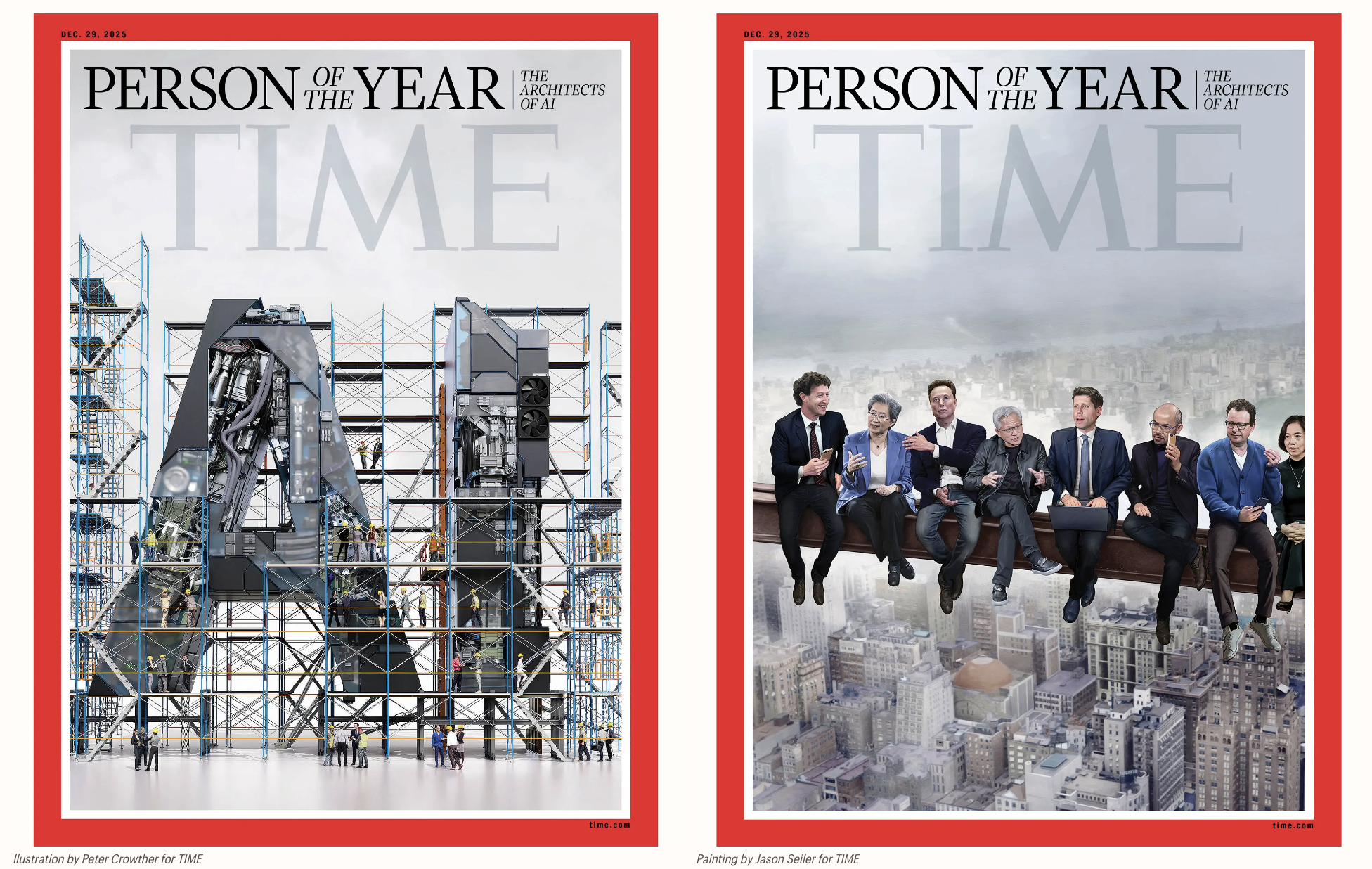
Time said that “the debate about how to wield AI responsibly gave way to a sprint to deploy it as fast as possible.” The publication added that “thanks to Huang, Son, Altman, and other AI titans, humanity is now flying down the highway, all gas no brakes, toward a highly automated and highly uncertain future.”
This depiction captures the dominance of leading firms racing to deliver new AI systems while facing questions around regulation, safety, and ethics.
A milestone year for AI
AI’s explosive growth defined 2025. Forrester analyst Thomas Husson told ABC News that this year represented “the point where AI shifted from a novel technology explored by early adopters to one where a critical mass of consumers see it as part of their mainstream lives.” He noted that “most consumers use it without even being aware of it,” as it now powers smartphones, search engines, and productivity applications.
OpenAI’s ChatGPT surpassed 800 million weekly users, as confirmed by CEO Sam Altman in September. Major technology firms have poured billions into infrastructure designed to support faster AI model deployment. Nvidia, which dominates the high-end chip market, has become the world’s most valuable company, crossing the $5 trillion mark, according to Reuters. Its founder, Jensen Huang, described AI as “the single most impactful technology of our time.”
The recognition, however, arrived on a volatile day for global markets. As CNN reported, shares in Oracle fell more than 14% after the firm revealed steep AI-related costs, dragging other major AI-associated stocks lower. Yet, despite market turbulence, investor and user enthusiasm for AI remains intense.
The promise and risk behind AI leadership
Time’s feature also reflected on the tension between innovation and responsibility. The magazine wrote that the rise of artificial intelligence has impressed and concerned observers, as models now generate code, design materials, and influence creative industries. Analysts and researchers warn of challenges such as bias, energy consumption, and job disruption.
“Humanity will determine AI's path forward, and each of us can play a role in determining AI's structure and future,” Jacobs said.
Nik Kairinos, founder and CEO of Fountech AI, echoed the sentiment, telling BBC that AI’s recognition was “an honest assessment” but that “recognition should not be confused with readiness.”
He added,
“At this moment, AI can still be a saviour or scourge to humanity. We are still in the early stages of building AI systems that are dependable, accountable, and aligned with human values.”
Legacy and influence of Time’s selection
Time’s annual Person of the Year tradition dates back to 1927, when the magazine named Charles Lindbergh as its first honoree. The title recognizes the person, group, or idea that most affected the news and global discourse during the year.
2025’s “Architects of AI” continue that tradition by representing a major technological shift. The individuals behind this transformation have not only altered the mechanics of innovation but also forced society to reconsider what intelligence, creativity, and control mean in the digital age.
 Anastasiia G
Disclaimer: All materials on this site are for informational purposes only. None of the material should be interpreted as investment advice. Please note that despite the nature of much of the material created and hosted on this website, HODL FM is not a financial reference resource, and the opinions of authors and other contributors are their own and should not be taken as financial advice. If you require advice. HODL FM strongly recommends contacting a qualified industry professional.