





Shares of Upexi (UPXI) fell sharply Tuesday after the company submitted a filing to the U.S. Securities and Exchange Commission (SEC) to raise up to $1 billion. The planned raise would expand Upexi’s Solana (SOL) treasury holdings and support related token and staking initiatives, even as the firm’s holdings have dropped more than 50% in value since September.
Shares fall as $1 billion capital plan unveiled
According to FORM S-3, a registration statement filed under the Securities Act of 1933, Upexi’s planned offering may include common and preferred stock, debt securities, warrants, and units, issued periodically. The company said the proceeds would go toward general corporate expenses, with most funds directed toward acquiring more Solana tokens and staking them to earn network rewards.
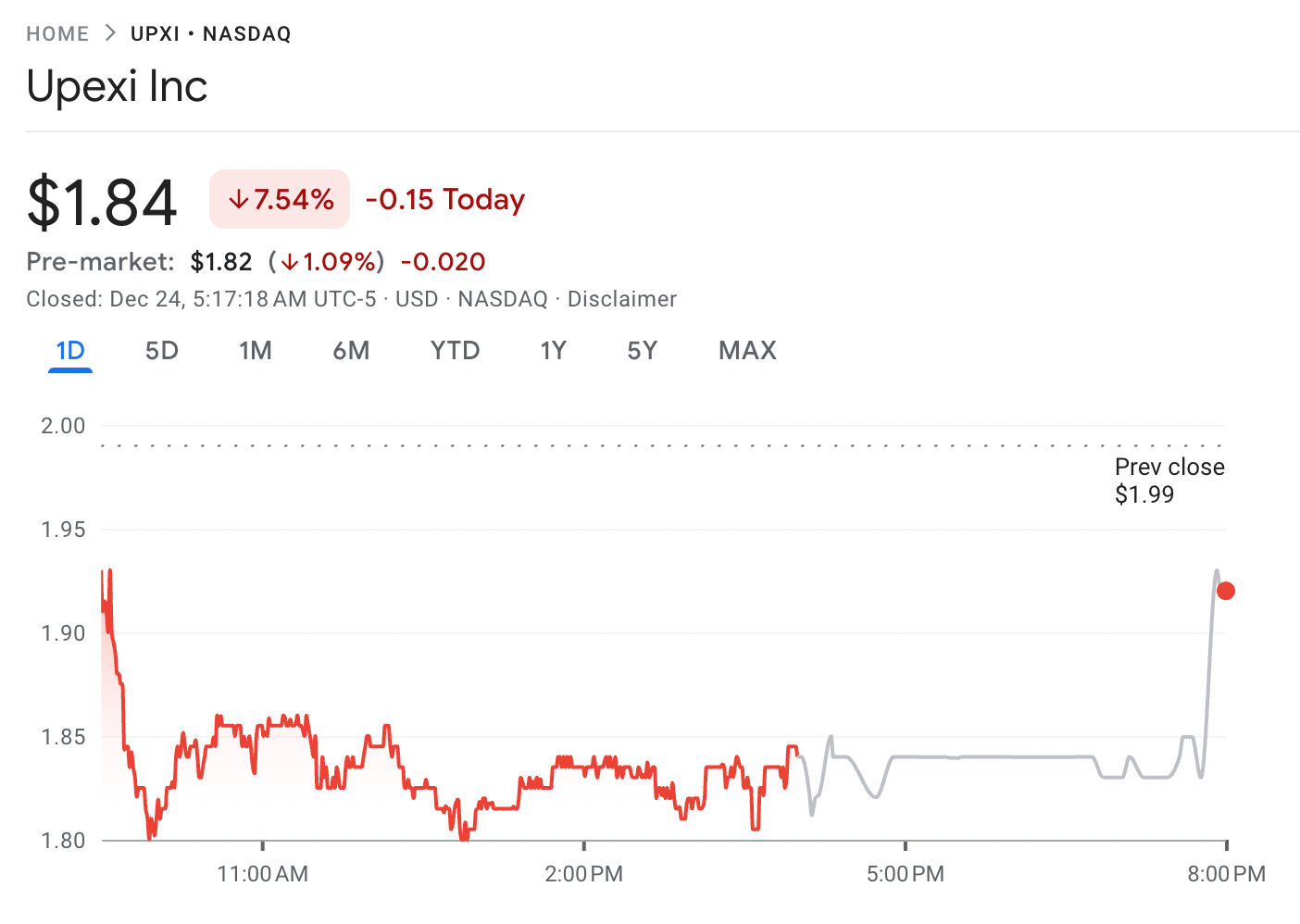
Upexi’s stock closed Tuesday down 7.5% at $1.84, according to Google Finance data. The stock later lost 1.09% in after-hours trading to $1.82. The decline followed investor concerns that the large-scale funding plan could dilute existing shares amid volatile cryptocurrency market conditions.
Upexi pivots to Solana-focused business model
The company currently holds 2.02 million SOL, valued around $246.3 million, according to CoinGecko data. This makes Upexi the fourth-largest corporate Solana treasury. The firm adopted its Solana-focused strategy in late April 2025, moving away from its former identity as a consumer products and e‑commerce company.
In the filing, Upexi reaffirmed its long-term focus on Solana-based treasury operations. Since July 23, it hasn't bought any more Solana, which is a sign of a general slowdown in the growth of institutional crypto treasuries in the second half of 2025.
The company reported a paper loss of around 19% on its Solana portfolio. At its peak in mid‑September, Upexi’s SOL holdings were worth roughly $525 million, but the decline in Solana’s market price has cut that valuation by half.
Solana’s market value continues to weaken
At the time of writing, Solana traded near $122.75, according to TradingView data, down 58% from its all‑time high of $293.31, reached in January 2025.
The drop has affected firms with token-heavy treasury strategies, including Upexi. Corporate investors that tied significant parts of their balance sheets to digital assets have faced mounting pressure as token prices fell throughout the year.
Upexi’s slowdown mirrors a regional and institutional trend in crypto investment activity. After several months of record‑high prices and staking rewards in the first half of the year, both corporate and retail participation in treasury accumulation declined sharply in the second half.
Solana network shows resilience after major cyber incident
Despite the price pressure, the Solana network itself has remained operationally stable in recent months. As Solana Floor reported earlier this month, Solana successfully withstood one of the largest distributed denial‑of‑service (DDoS) attacks on record, with peak traffic of almost 6 terabits per second. The attack lasted for more than a week but did not interrupt transaction processing.
Network data showed that Solana maintained sub‑second transaction confirmation times throughout the event. Analysts cited the network’s improved validator infrastructure and upgraded communication framework as key factors that prevented outages.
The attack placed Solana in a similar league to Google Cloud, Cloudflare, and Amazon Web Services (AWS), which have faced network‑scale DDoS attacks in recent years.
Broader implications for Upexi and the Solana ecosystem
The new filing reflects both Upexi’s commitment and exposure to Solana. The company remains one of the few corporates with heavy on‑chain treasury positions tied to a specific Layer‑1 blockchain. While the $1 billion raise could reinforce its token holdings if approved by regulators, there are potential risks associated with over-reliance on volatile digital assets.
Upexi’s strategy differs sharply from traditional corporate treasury management, in which companies typically diversify into low‑risk assets. The company's approach shows that they still believe in Solana's long-term viability, even though the market is weak right now.
 Oleksii Shumak
Disclaimer: All materials on this site are for informational purposes only. None of the material should be interpreted as investment advice. Please note that despite the nature of much of the material created and hosted on this website, HODL FM is not a financial reference resource, and the opinions of authors and other contributors are their own and should not be taken as financial advice. If you require advice. HODL FM strongly recommends contacting a qualified industry professional.