

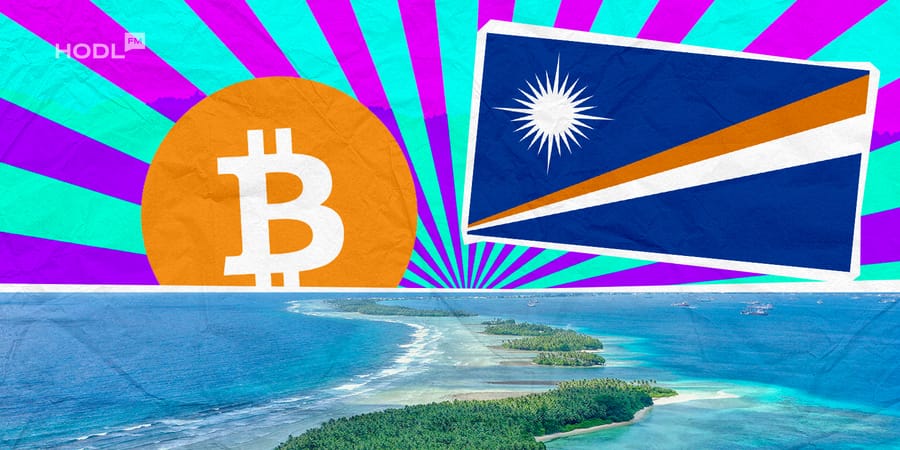



The Republic of the Marshall Islands has become the first country to introduce a national universal basic income (UBI) scheme that integrates cryptocurrency payments. The government said the initiative aims to cushion living costs while expanding financial access across its scattered Pacific islands.
A national safety net for all citizens
Under the program, every resident of the Marshall Islands is entitled to quarterly payments of about $200, totaling roughly $800 per year. The Ministry of Finance stated the first distribution took place in late November.
Citizens can choose how they wish to receive their payments: through bank deposits, paper checks, or a government-backed digital wallet that uses blockchain technology for on-chain transfers.
Finance Minister David Paul told The Guardian,
“We the government want to make sure no one is left behind.” He added, “$200 per person per quarter, which is about $800 a year, does not compel you to quit your job … but it’s actually like a morale booster for people.”
Home to around 42,000 residents, the Marshall Islands face persistent challenges due to remote geography, high import dependence, and migration pressures. Paul said the UBI is designed to provide a “social safety net” for citizens affected by rising costs and economic instability.
Funded by trust and supported by technology
The program is financed by a sovereign trust fund established through an agreement with the United States, which also compensates the island nation for decades of U.S. nuclear testing. The fund currently manages over $1.3 billion in assets, with an additional $500 million committed by Washington through 2027.
The blockchain-based component allows payments through a stablecoin pegged to the U.S. dollar, ensuring value stability and transaction transparency. The platform supporting the UBI, locally branded as ENRA, uses the USDM1 digital sovereign bond on the Stellar blockchain.
A spokesperson for the Finance Ministry said,
“USDM1 is issued under New York law using a time-tested Brady-bond structure that has underpinned sovereign finance for decades.” The spokesperson added, “U.S. Treasury collateral is held by an independent trustee, outside the control of any government or private issuer, and redemption rights are fixed, unconditional, and legally enforceable.”
Mixed adoption but strong symbolic value
While the rollout represents a technological first, adoption of the crypto payment option remains limited. Data from the Marshall Islands Social Security Administration shows that about 60% of recipients have opted for direct deposits, nearly all others for checks, and only a few dozen for digital wallets.
Finance manager Anelie Sarana, who helped lead the registration process, said her team spent months traveling to outer islands to onboard residents. She observed that many people used the payments immediately for food and basic supplies, while others used the funds to celebrate the Gospel Day holiday, which coincided with the first payout.
“I know they’re happy, because you can see in the streets, there’s so much traffic, it’s like there’s a big something happening,” she said in remarks to The Guardian.
Global significance and remaining challenges
Experts have described the Marshall Islands program as a global first. Dr. Huy Pham, associate professor and crypto-fintech lead at RMIT University, told The Guardian that the initiative “is the world first for a national rollout of a UBI program.” He described the use of blockchain as “unique in terms of a nation-wide implementation.”
However, connectivity remains an obstacle. Pham noted that limited internet access and smartphone penetration could impede digital inclusion. He said, “Improving internet coverage, improving smartphone penetration – all these kinds of things are the minimum for a blockchain-based economy.”
The International Monetary Fund (IMF) has also cautioned that blockchain-linked benefits programs may pose “financial, fiscal, legal, reputational, and financial integrity risks” without strong governance.
Still, the experiment has attracted academic interest. Dr. Monique Taylor of the University of Helsinki told The Guardian that while outcomes remain uncertain, the program “may lower frictions and make transfers more accessible, particularly in outer atolls.”
With this hybrid model of digital and traditional payments, the Marshall Islands has positioned itself as a global pioneer in blending social policy with blockchain infrastructure, testing how technology can deliver equitable access to financial support.
 Roman Zaika
Disclaimer: All materials on this site are for informational purposes only. None of the material should be interpreted as investment advice. Please note that despite the nature of much of the material created and hosted on this website, HODL FM is not a financial reference resource, and the opinions of authors and other contributors are their own and should not be taken as financial advice. If you require advice. HODL FM strongly recommends contacting a qualified industry professional.