




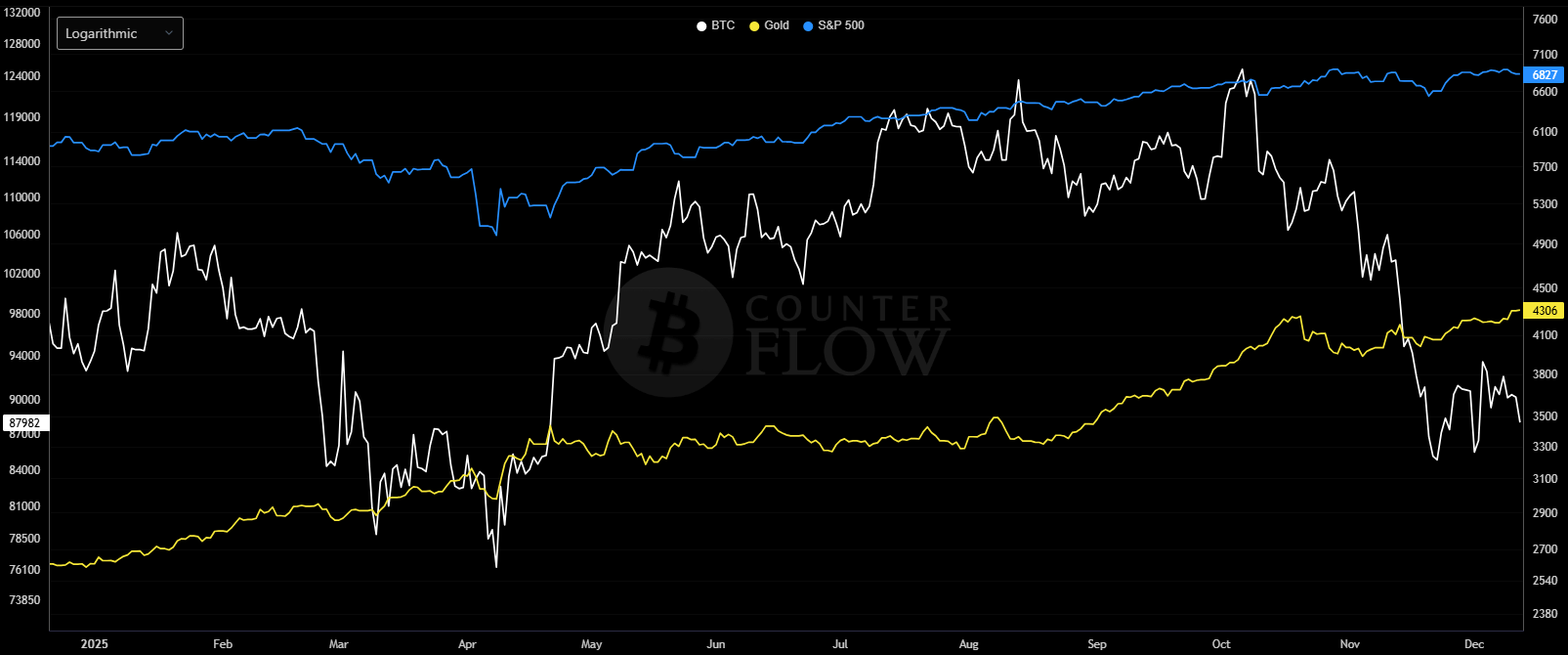
Silver spent the final weeks of 2025 doing what Bitcoin was supposed to do. After breaking out of the $50 range in late November, the metal surged into year-end, printing consecutive all-time highs and reaching $72 an ounce on Dec. 24.
Gold followed a similar path, climbing steadily throughout the year and touching $4,524 on the same day.
Bitcoin, by contrast, went nowhere.
As of late December, BTC traded near $87,500, down about 8% on the year and roughly 30% below its October peak near $126,000. For a market that spent much of 2024 framing Bitcoin as “digital gold,” the divergence is hard to ignore.
The takeaway is not that Bitcoin failed, but that the market is making sharper distinctions about what qualifies as a safe haven.
A hard-asset regime, just not a crypto one
The macro backdrop in 2025 looked tailor-made for scarce, non-yielding assets. The dollar weakened, real yields compressed, expectations for Federal Reserve rate cuts in 2026 solidified, and geopolitical tensions remained elevated. Those conditions powered gold and silver higher.
Bitcoin was expected to benefit from the same forces. Instead, it spent much of the year consolidating or retracing, even as spot Bitcoin ETFs attracted inflows and US regulatory pressure eased.
That gap suggests the market is in a hard-asset regime, but one that currently favors tangible hedges with long-established credibility. Gold absorbed central bank demand. Silver captured both safe-haven flows and industrial buying. Bitcoin, meanwhile, continued to trade like a high-beta asset that needs liquidity and narrative momentum to outperform.
Research published throughout 2025 supports that behavior. Gold and diversified commodities showed consistent safe-haven characteristics across different shocks, while Bitcoin’s hedging properties remained conditional and often correlated with equities. When fear dominates, investors still default to assets with centuries of history.
Why silver ran without Bitcoin
Silver’s rally was not driven by macro fear alone. Industrial demand played a decisive role. Tight supply conditions, rising photovoltaic usage, grid expansion, and electronics manufacturing created structural pressure that had little to do with risk sentiment.
Saxo Bank highlighted those constraints in November, noting limited substitution options for silver in key supply chains. That industrial bid gives silver a durability that Bitcoin does not have. Even if risk appetite fades or rate expectations shift, a baseline level of physical demand remains.
Bitcoin lacks that buffer. ETF inflows help, but they are cyclical and vulnerable to reversals. When flows turn negative, there is no underlying consumption demand to stabilize price action.
This difference explains much of the performance gap without implying anything structurally bearish about Bitcoin. Silver’s move reflects two forces at once: macro tailwinds that could eventually favor Bitcoin, and secular demand that is unique to metals.
Reading the signal correctly
Silver’s surge is not a signal to rotate into or out of Bitcoin. It functions more like a macro barometer. Markets are pricing lower real rates, a weaker dollar, and a preference for hedges they expect to behave predictably under stress.
That environment does not exclude Bitcoin permanently, but it delays its participation. For Bitcoin to rejoin the broader hard-asset trade, something else has to change: institutional allocation patterns, retail sentiment after 2025’s drawdowns, or a macro shock where Bitcoin’s portability and censorship resistance matter more than gold’s history or silver’s utility.
None of those catalysts come from metals markets.
There is also risk in silver itself. If the trade becomes crowded, a hawkish policy surprise or dollar squeeze could trigger a sharp unwind. Any resulting volatility would likely spill across asset classes, including crypto, through positioning and liquidity channels rather than any direct linkage.
 Maryna Hornieieva
Disclaimer: All materials on this site are for informational purposes only. None of the material should be interpreted as investment advice. Please note that despite the nature of much of the material created and hosted on this website, HODL FM is not a financial reference resource and the opinions of authors and other contributors are their own and should not be taken as financial advice. If you require advice of this sort, HODL FM strongly recommends contacting a qualified industry professional.