




Memecoins have long been dismissed as joke assets or fleeting trends, yet their core innovation lies not in humor, but in the technology enabling them.
According to Keith A. Grossman, president of payment infrastructure company MoonPay, these tokens are far from dead. Rather, they are poised to return in a new form, driven by the ability to tokenize attention cheaply and efficiently through blockchain.
“Before crypto, attention could only be monetized by platforms, brands, and a few influencers,” Grossman explained.
This democratization of attention represents a significant shift in the digital economy.
“The majority of users generated value for free, likes, trends, inside jokes, communities all creating economic value that rarely flowed back to them.”
While analysts have grown skeptical, comparing memecoin hype to the speculative failures of early social networks in the 2000s, history suggests that nascent technologies often experience cyclical reinvention before establishing lasting impact.
The rise and fall of 2024’s Memecoin market
Memecoins were among the top-performing crypto assets in 2024, capturing significant investor attention. Data from CoinGecko shows they were a dominant narrative, fueled by enthusiastic communities and viral adoption. Yet the market also faced sharp criticism. Several high-profile token collapses, often described as “rug pulls,” eroded confidence and led to major drawdowns.
Political figures entered the scene, sometimes exacerbating volatility. In early 2025, a memecoin launched by former U.S. President Donald Trump peaked at $75 before plummeting over 90% to around $5.42. Similarly, Argentina’s President Javier Milei endorsed the Libra token, which ultimately lost 86% of its value, triggering government probes, lawsuits, and political backlash.
From Dogecoin to today. The evolution of Memecoins
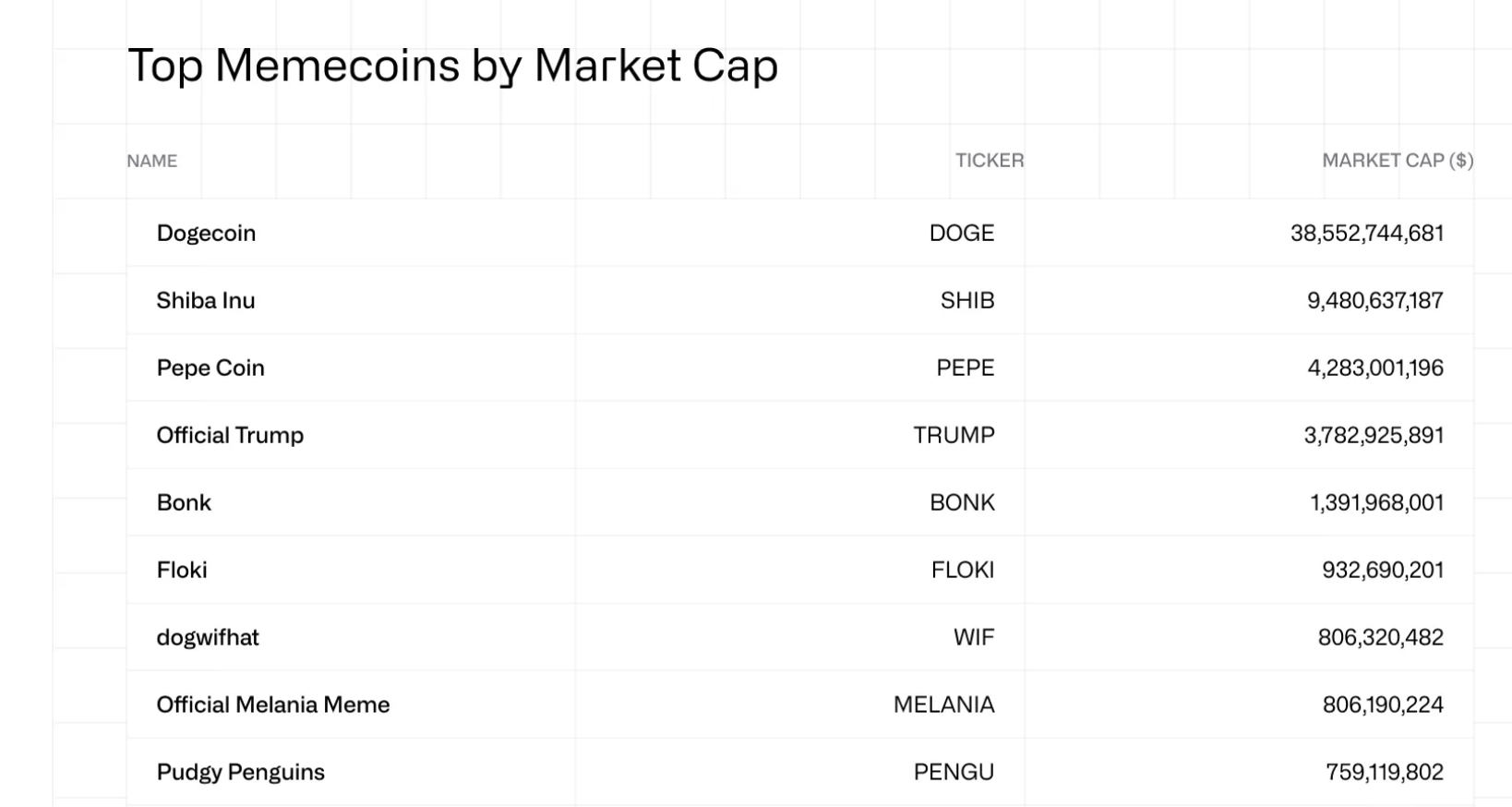
The memecoin phenomenon began in earnest with Dogecoin in 2013, inspired by the viral Japanese dog Kabosu. Unlike common belief, Dogecoin was created to satirize the proliferation of Bitcoin copycats rather than Bitcoin itself. Built on Litecoin’s proof-of-work protocol, it was accessible for miners using modest hardware, and its unlimited supply encouraged broad participation.
Dogecoin quickly gained traction through community engagement rather than market fundamentals. Its subreddit rallied support for real-world causes, including funding the Jamaican Bobsled Team at the 2014 Sochi Olympics and sponsoring water wells in Kenya. Celebrity endorsements, most notably Elon Musk calling it “the people’s crypto,” further cemented its cultural status. Today, Dogecoin remains a benchmark for community-driven digital currencies.
Following Dogecoin, other memecoins have carved unique paths. Pepe, inspired by Matt Furie’s frog, integrates a deflationary mechanism and has reached a valuation of $4.4 billion. Shiba Inu, another community-backed token, leveraged Ethereum’s layer-2 protocol Shibarium to enhance scalability, reaching a $10 billion market cap despite significant coin concentration in the founder’s hands a recurring challenge in the sector.
Platforms fueling the Memecoin surge
The rapid proliferation of memecoins owes much to no-code launch platforms like Pump.fun, founded in 2024. By enabling anyone to deploy a token on Solana in two clicks, these platforms democratize access to crypto markets while creating liquidity pools on decentralized exchanges. Notable tokens launched via Pump.fun include FARTCOIN ($729 million) and WOULD ($306 million), with the platform’s total market cap exceeding $5.5 billion by February 2025.
Pump.fun’s growth mirrored Solana’s resurgence, generating nearly $500 million in fees in 2024. Competitors such as Daos.fun and Moonshot are following suit, offering mobile-friendly access and broadening investor reach. These platforms have also highlighted risks, including insider trading and rug pulls, exemplified by the TRUMP and MELANIA tokens and other smaller speculative launches.
The Current State of Meme Coins. Decline and Debate
Despite earlier surges, meme coins have faced a sharp downturn in 2025, prompting some experts to declare the sector “dead.” CryptoQuant CEO Ki Young Ju pointed to chain data showing meme coin dominance in altcoin markets dropping to 0.034, its lowest level since February 2024.
Data from CoinGecko and Artemis confirm the trend: Dogecoin (DOGE) fell 66%, Shiba Inu (SHIB) 71%, Pepe (PEPE) 82%, and Bonk (BONK) 76%, with the broader meme coin market down nearly 66%.
The slump has been especially pronounced in Solana-based projects. Joao Weidson, CEO of Alfractals, described the ecosystem’s meme coins and altcoins as entering their “worst phase,” noting that while payment-focused altcoins remain resilient, speculative tokens have struggled to maintain trust and liquidity. Analysts cite multiple causes, including low-cost launches susceptible to fraud, pump-and-dump schemes, and market oversaturation.
 Anastasiia G
Disclaimer: All materials on this site are for informational purposes only. None of the material should be interpreted as investment advice. Please note that despite the nature of much of the material created and hosted on this website, HODL FM is not a financial reference resource, and the opinions of authors and other contributors are their own and should not be taken as financial advice. If you require advice. HODL FM strongly recommends contacting a qualified industry professional.