





Ethereum has slipped below the $3,000 mark for the first time in months, a move that has deepened downside momentum and raised concerns that the current sell-off may not be finished.
ETH is down roughly 7% over the past 24 hours and more than 16% from recent highs above $3,200, according to CoinMarketCap data.
The breakdown comes amid broader market weakness, with Bitcoin sliding below $90,000 and briefly touching $89,500 across major exchanges.
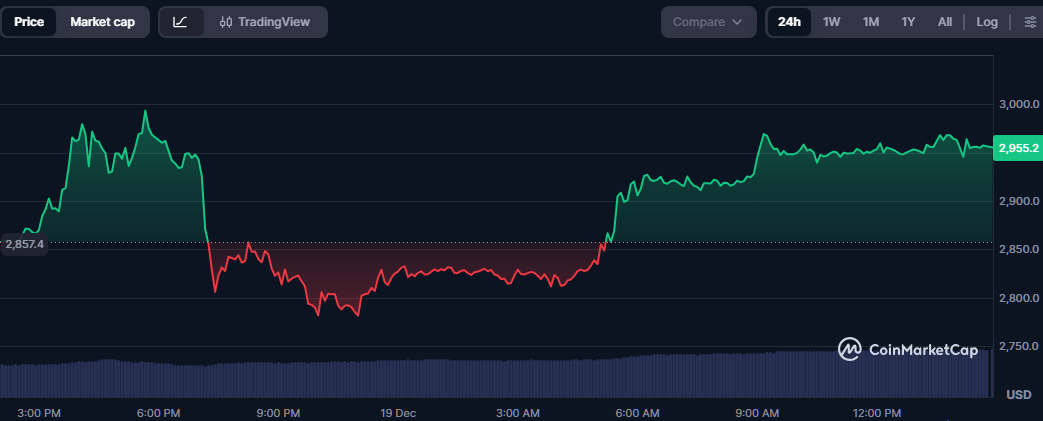
A key psychological and technical level gives way
The $3,000 zone had acted as both a psychological floor and a technical balance area for Ethereum. Its failure marks a shift in structure, with the level now acting as resistance rather than support.
ETH traded as low as $2,940 on Tuesday before stabilizing near $2,980.
Attempts to rebound have so far stalled, suggesting that buyers are struggling to regain control. From a market structure perspective, the loss of a high-volume area often signals acceptance of lower prices rather than a temporary breakdown.
This weakness persists despite notable accumulation by BitMine, which disclosed it purchased an additional 54,156 ETH over the past week, bringing its total holdings to roughly 3.56 million ETH. The buying, however, has not been enough to counter broader sell-side pressure.
Broader market stress adds to downside risk
Ethereum’s decline has unfolded alongside renewed pressure in Bitcoin, which remains the dominant force in crypto market direction. BTC’s drop below $90,000 has amplified risk aversion across altcoins, reinforcing a “sell first, reassess later” environment.
Thomas “Tom” Lee, chairman of BitMine, recently pointed to lingering liquidity issues following the October liquidation event as a potential driver of the ongoing weakness.
In his view, reduced market-making activity can resemble a form of quantitative tightening, dampening prices until balance sheets recover. Similar conditions in past cycles have taken several weeks to resolve.
“When a market maker has a ‘hole’ on their balance sheet, they are seeking to raise capital and are reducing their liquidity functions in the market. This is the equivalent of QT (quantitative tightening) for crypto and has the effect of dampening prices. In 2022, this QT effect lasted for 6-8 weeks. And this is probably happening today.”
Meanwhile, US spot Ethereum ETFs continue to see net outflows, removing a key source of structural demand at a time when sentiment is already fragile.
Riya Sehgal, Research Analyst, Delta Exchange said that Crypto markets saw a sharp sell-off over the past 24 hours, with Bitcoin down 4%, Ethereum falling 5.7%, Solana declining 4.4%, and XRP leading losses with a 6.4% drop and this move was accompanied by heavy forced unwinds across derivatives markets, where over 183,500 traders were liquidated, taking total liquidations to approximately $592 million in a single day.
Liquidations and indicators tilt bearish
Derivatives data adds to the caution. Coinglass shows more than $175 million in ETH liquidations over the past 24 hours, with roughly $136 million tied to long positions. Such imbalances often accelerate downside moves once key levels give way.
Technical indicators echo that message.
The daily relative strength index has continued to drift lower, while the MACD histogram remains firmly negative. Volume has also favored sell-side activity, suggesting conviction remains with bears for now.
Where price could head next
With $3,000 now overhead resistance, attention is shifting to lower liquidity zones. The $2,800 area stands out as a near-term level where buyers may attempt to slow the decline. A failure there would expose deeper downside targets around the $2,300 to $2,230 range, levels last seen earlier this year.
On the upside, any recovery attempt faces immediate pressure. The path back toward $3,300 would require a sustained reclaim of $3,000, supported by stronger volume and improving market breadth, conditions that are currently absent.
 Tanya Petrusenko
Disclaimer: All materials on this site are for informational purposes only. None of the material should be interpreted as investment advice. Please note that despite the nature of much of the material created and hosted on this website, HODL FM is not a financial reference resource, and the opinions of authors and other contributors are their own and should not be taken as financial advice. If you require advice. HODL FM strongly recommends contacting a qualified industry professional.