





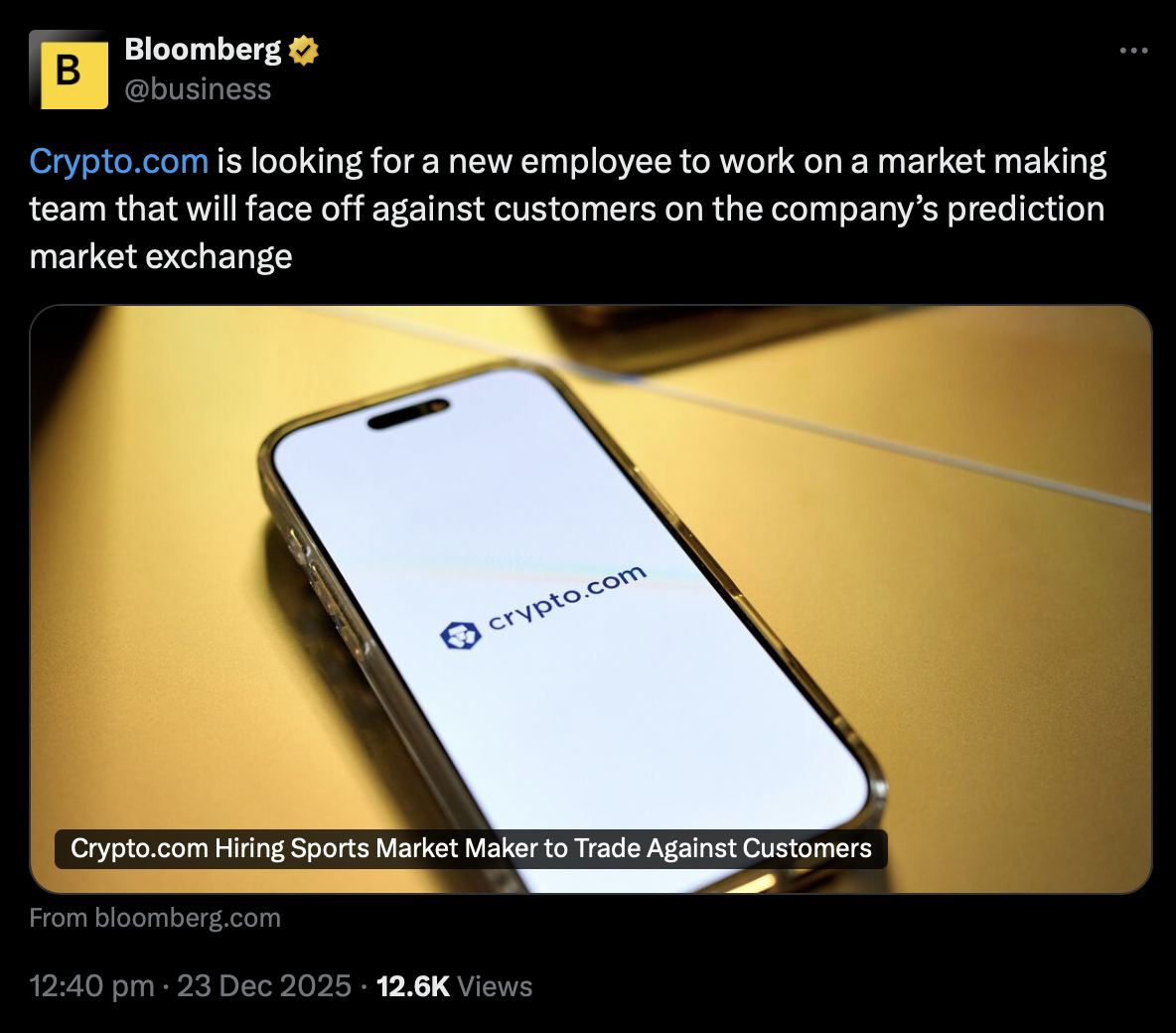
Crypto.com is building an internal market-making team to support its growing prediction markets business, saying the move is compliant with US regulations and does not give the exchange an unfair advantage over customers.
The plan surfaced this week after Bloomberg reported that Crypto.com is recruiting a quantitative trader to help buy and sell contracts linked to the outcomes of sporting events on its prediction platform. The role would sit within an in-house market-making desk, rather than relying exclusively on external liquidity providers.
Internal market making has long been a sensitive topic in both traditional and crypto markets, particularly when an exchange trades on the same venue it operates. Critics often point to potential conflicts of interest, especially in newer products like outcome-based contracts.
How Crypto.com frames the move
Crypto.com says its internal market maker is fully disclosed to the US Commodity Futures Trading Commission and operates under the same rules as external liquidity providers on its North American derivatives platform.
According to the company, the goal is straightforward: tighter spreads and more reliable liquidity.
“The bottom line for customers is that more competition and liquidity on the platform creates a better overall experience,” a Crypto.com spokesperson said.
The exchange also rejected the idea that its internal traders receive preferential treatment. The spokesperson said the market-making team does not have access to customer order flow or proprietary data ahead of other participants, and does not get any “first look” advantage.
Crypto.com added that proprietary trading is not a core revenue driver for the business. Instead, the exchange describes itself as risk-neutral, generating revenue primarily through fees charged to retail users.
Prediction markets and conflict concerns
Prediction markets have drawn increasing regulatory and political attention as they expand beyond niche communities into mainstream finance. Because contracts are tied to real-world outcomes from elections to sports, regulators tend to scrutinize how liquidity is provided and whether exchanges can influence prices.
That scrutiny intensifies when platforms trade against users directly, even if safeguards are in place. In response, exchanges have leaned on disclosure, structural separation, and regulatory oversight to justify internal market-making models.
Crypto.com’s approach mirrors arguments used across derivatives markets, where designated market makers are common and often essential for functional order books.
Not an isolated practice
Crypto.com is not alone in using professional liquidity providers for prediction markets.
Kalshi, a federally regulated event-contracts exchange, relies on designated market makers rather than a purely peer-to-peer structure. Public reporting has linked quantitative trading firm Susquehanna International Group to Kalshi’s liquidity operations since 2024, particularly as volumes increased.
Polymarket, a decentralized prediction market that gained prominence during the US presidential election cycle, is also building its own internal market-making unit.
As prediction markets mature, the debate is shifting away from whether market makers should exist, and toward how transparent and constrained their role should be. Crypto.com’s hiring push suggests that exchanges see liquidity control as a competitive necessity, even as regulators and users continue to test where the lines should be drawn.
 Gunel Ismayilova
Disclaimer: All materials on this site are for informational purposes only. None of the material should be interpreted as investment advice. Please note that despite the nature of much of the material created and hosted on this website, HODL FM is not a financial reference resource, and the opinions of authors and other contributors are their own and should not be taken as financial advice. If you require advice. HODL FM strongly recommends contacting a qualified industry professional.