





Bitcoin has continued to drain from centralized exchanges, reinforcing a trend that has been building throughout the year.
According to market-intelligence platform Santiment, there are at least 400,000 fewer Bitcoin on exchanges compared with this point last year, a shift the firm views as constructive for the market’s long-term health.
As the firm wrote in its recent post on X,
“In general, this is a positive long-term sign. The less coins exist on exchanges, the less likely we’ve historically seen a major sell-off that causes downside pressure for an asset’s price.”
📊 As Bitcoin's market value hovers around $90K, crypto's top market cap continues to see its supply moving away from exchanges. Over the past year, there has been:
— Santiment (@santimentfeed) December 8, 2025
📉 A net total of -403.2K $BTC moving off exchanges
📉 A net reduction of -2.09% of $BTC's entire supply moving… pic.twitter.com/Y0JTC880Np
ETFs are absorbing a growing share of supply
Santiment’s latest figures show over 403,000 BTC, worth roughly $90,197 per coin, moving off exchanges since Dec. 7, 2024. That reduction represents about 2% of Bitcoin’s total supply, based on data published through the company’s Sanbase dashboard.
A portion of those coins appears to be headed into private custody, where holders generally store assets for extended periods. Santiment noted that this pattern has historically aligned with calmer selling conditions.
“As Bitcoin's market value hovers around $90K, crypto’s top market cap continues to see its supply moving away from exchanges.”
Not all of the outgoing supply is simply returning to personal cold-storage wallets. Some of it is being absorbed by investment vehicles that have been accumulating quietly for years.
Giannis Andreou, founder and CEO of Bitmern Mining, pointed to data from BitcoinTreasuries.net, which shows that ETFs and publicly traded companies now hold more Bitcoin than all exchanges combined.
Andreou described the shift as a deeper structural change, driven by regulated products that steadily acquire Bitcoin rather than trade it frequently.
As he explained,
“Institutional ownership has quietly crossed into a new phase: less liquid supply, more long-term holders, stronger price reflexivity, a market driven by regulated vehicles, not trading platforms.”
adding,
“This shift is bigger than people think. Bitcoin isn’t moving to exchanges anymore. It’s moving off them straight into institutions that don’t sell easily. The supply squeeze is building in real time.”
Recent disclosures highlight how persistent this accumulation has become.
Strategy, for example, expanded its treasury past 660,000 BTC after an additional $962 million purchase, continuing a strategy it has followed for several years.
ETFs and companies hold more Bitcoin than exchanges
Separate data supports the broader trend. Analytics platform CoinGlass shows that exchange-based holdings sat at roughly 2.11 million BTC as of Nov. 22, a period when Bitcoin briefly corrected and traded around $84,600.
Meanwhile, BitBo lists more than 1.5 million BTC held by ETFs and over one million BTC owned by public companies.
Together, those figures account for nearly 11% of the entire Bitcoin supply, a concentration that did not exist in prior market cycles.
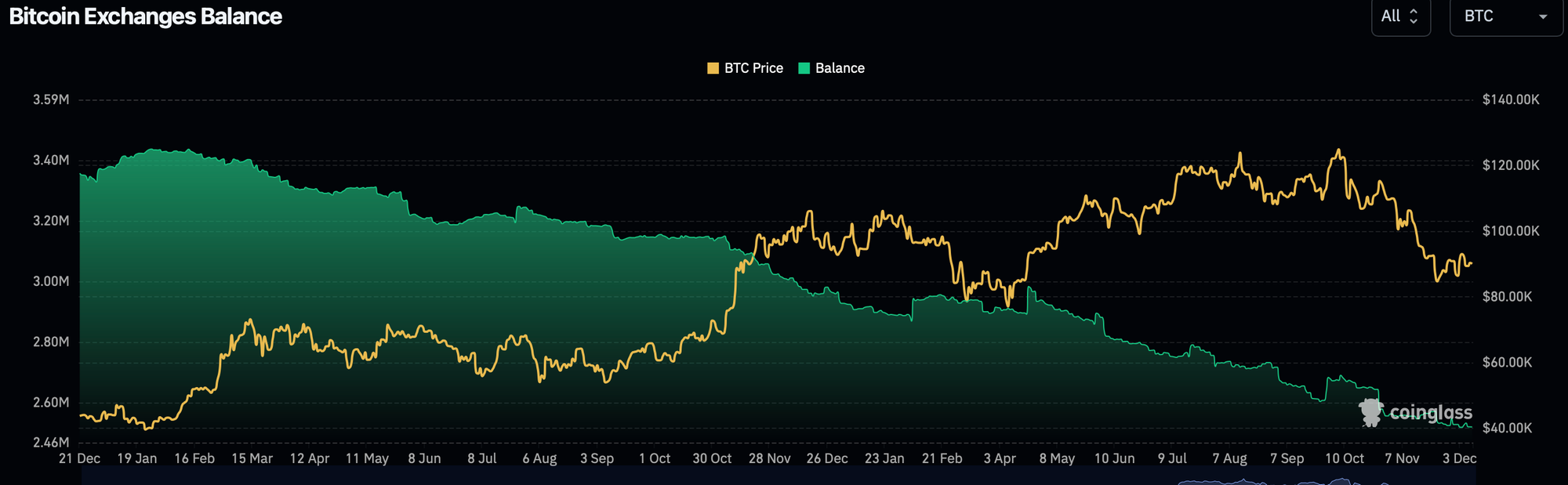
As coins migrate into long-term custody and regulated products, the pool of readily available Bitcoin on exchanges continues to shrink. The trend does not guarantee any specific price outcome, but it illustrates how the market is gradually shifting toward holders and institutions that tend to keep their assets off the table for extended periods.
 Oleksii Shumak
Disclaimer: All materials on this site are for informational purposes only. None of the material should be interpreted as investment advice. Please note that despite the nature of much of the material created and hosted on this website, HODL FM is not a financial reference resource, and the opinions of authors and other contributors are their own and should not be taken as financial advice. If you require advice. HODL FM strongly recommends contacting a qualified industry professional.