


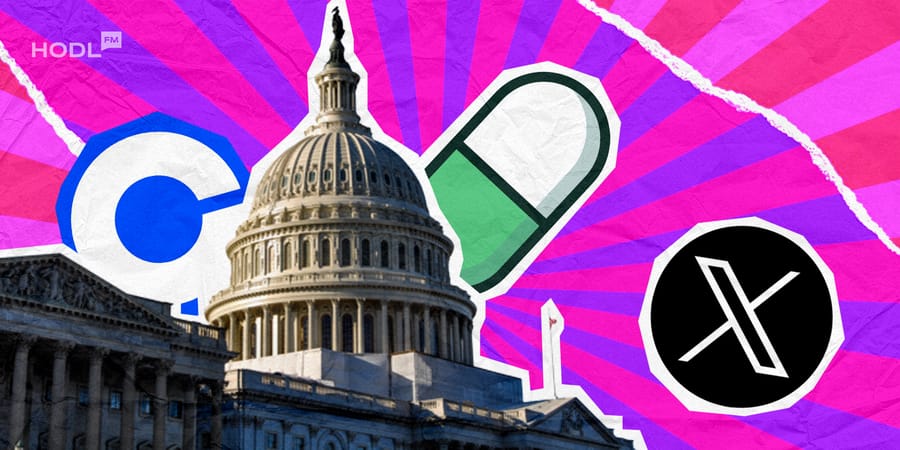


Crypto markets opened the week with a familiar mix of policy pressure, platform maneuvering, and large on-chain movements.
In Washington, lawmakers moved closer to drawing formal limits around stablecoin rewards, reopening a fault line between banks and major exchanges. At the same time, Coinbase signaled it may pull political support if those limits cut too deep, while Pump.fun-linked wallets sent another nine-figure tranche of stablecoins to Kraken, keeping treasury questions in focus.
Elsewhere, X continued its push toward becoming a real-time financial hub, testing new tools that tie market prices directly into social conversations.
Yet first, let's take a look at our weekly Gainers and Losers section.
Top gainers and losers
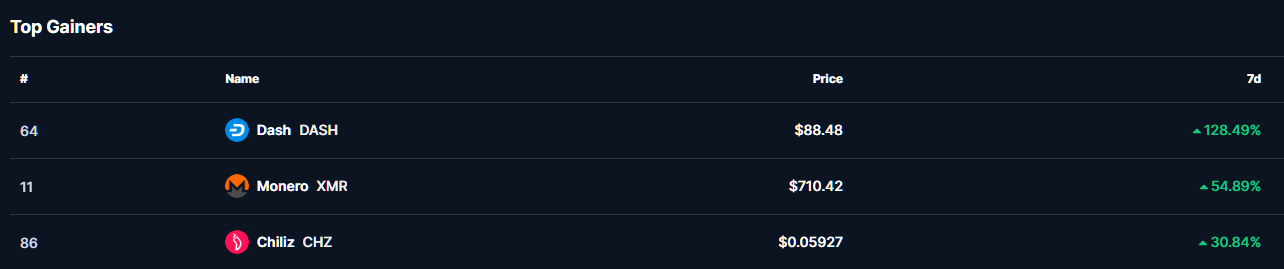
- Dash (DASH) - amazing growth of 128.49% this week to a price of $88.48
- Monero (XMR) - 54.89% growth to a price of $710.42
- Chillz (CHZ) - 30.84% rise to a price of $0.05927

- Ligther (LIT) - 37.95% drop to a price of $1.90
- Litecoin (LTC) - 10.45% loss with the week end price of $72.48
- Midnight (NIGHT) - 8.19% drop to a price of $0.06377
X readies ‘Smart Cashtags’ to link stocks and crypto to live prices
X is developing a feature called Smart Cashtags that will turn ticker symbols in posts into links showing real-time market data, according to the platform’s head of product, Nikita Bier. The tool is designed to work across stocks and cryptocurrencies, allowing users to tag specific assets when posting symbols such as $BTC or $NVDA.
When tapped, a Smart Cashtag will open an in-app page displaying live prices, price movements, charts, and related posts. For crypto assets, X plans to reduce confusion caused by overlapping tickers by tying some cashtags directly to underlying smart contract addresses.
Bier said the feature is currently gathering user feedback, with a public rollout targeted for next month. X has not said whether Smart Cashtags will eventually connect to trading or monetization features.
The update fits into Elon Musk’s broader push to position X as a real-time financial information hub, alongside longer-term ambitions to build payments and financial services into the platform.
Coinbase warns it may drop CLARITY Act support over Stablecoin rewards
Coinbase has told U.S. lawmakers it could withdraw backing for the CLARITY Act if the bill limits stablecoin rewards beyond basic disclosure requirements, according to a Jan. 11 Bloomberg report. The warning comes as Congress prepares to mark up the long-awaited crypto market structure legislation later this week.
At the center of the dispute is Coinbase’s ability to offer rewards on stablecoin balances, particularly USD Coin (USDC). The exchange earns interest on reserves backing USDC through its partnership with Circle and passes part of that income to users, including rewards of about 3.5% for some Coinbase One customers. Those incentives encourage users to hold stablecoins on the platform and provide a meaningful revenue stream during slower trading periods. Bloomberg estimates Coinbase’s stablecoin-related revenue reached roughly $1.3 billion in 2025.
Some draft proposals tied to the CLARITY Act would restrict stablecoin rewards to banks or similarly regulated financial institutions. Banking groups have pushed for those limits, arguing that yield-bearing stablecoins could siphon deposits away from traditional banks and reduce lending capacity. Coinbase, which also holds a minority stake in Circle, sees that approach as a direct threat to competition in the stablecoin market.
The fight unfolds against the backdrop of the GENIUS Act, passed in July, which established a federal framework for stablecoin issuers. While that law prohibits issuers themselves from paying interest simply for holding stablecoins, it left room for third-party platforms to offer rewards. Coinbase executives argue that narrowing that carve-out would reopen compromises lawmakers already settled and skew the market toward banks.
Pump.fun-linked wallet deposits $148M in Stablecoins to Kraken
A wallet linked to Pump.fun transferred roughly $148 million in USDC and USDT to Kraken on Jan. 13, according to on-chain data reviewed by analyst EmberCN.
pump. fun 在 1 小时前再次向 Kraken 转移了 1.48 亿枚 ICO 销售 $PUMP 获得的 USDC 和 USDT。
— 余烬 (@EmberCN) January 13, 2026
他们从 11/15 以来两个月的时间,一共向 Kraken 转移了 7.53 亿枚在 2025 年 6 月份通过 ICO 销售 $PUMP 获得的 USDC 和 USDT。https://t.co/sxPo2OBBZw… https://t.co/KVmMPo7pai pic.twitter.com/h1JotuPvZp
EmberCN Original Post.
The funds originated from wallets associated with Pump.fun’s PUMP token sale in mid-2025. With the latest transaction, total stablecoins sent to Kraken since Nov. 15 now stand at about $753 million, based on publicly visible wallet activity tied to the sale.
Similar nine-figure transfers have appeared at regular intervals over the past two months. In several earlier cases, stablecoins deposited to Kraken were later traced to Circle-related addresses, a pattern that has prompted questions around redemptions or internal treasury movements.
Neither Pump.fun nor Kraken has commented on the latest transfer.
Pump.fun has previously said comparable transactions reflect routine treasury management rather than liquidation. The renewed attention comes as the platform faces criticism over its former creator fee model and slower revenue growth compared with peak memecoin trading periods. Co-founder Alon Cohen acknowledged flaws in the earlier structure this month and outlined plans to shift incentives toward traders and liquidity.
The transfer also arrives ahead of an expected court decision in an amended civil lawsuit accusing Pump.fun of racketeering and insider trading. While the on-chain movement is not directly tied to the case, it has added to scrutiny over how the project manages and discloses its funds.
Senate draft bars idle Stablecoin yields, allows activity-based rewards
U.S. senators unveiled a new market structure bill that would prohibit stablecoin yields for simply holding balances, while allowing rewards tied to specific user actions.
The bipartisan draft, released by Senate Banking Committee Chair Tim Scott, reflects negotiations with crypto firms and banks aimed at resolving one of the most contentious issues in the legislation.
Under the bill, incentives could be offered when users actively engage with stablecoins, rather than for balances that sit idle on a platform.
The proposal also incorporates protections for software developers and infrastructure providers, shielding them from being treated as financial intermediaries solely for maintaining or publishing code.
Ethics provisions related to President Donald Trump’s family crypto ventures were not included. The bill is scheduled for markup this week, with further reconciliation needed between Senate committees and the House’s Digital Asset Market Clarity Act before it can advance to a full vote.
 Gunel Ismayilova
Disclaimer: All materials on this site are for informational purposes only. None of the material should be interpreted as investment advice. Please note that despite the nature of much of the material created and hosted on this website, HODL FM is not a financial reference resource, and the opinions of authors and other contributors are their own and should not be taken as financial advice. If you require advice. HODL FM strongly recommends contacting a qualified industry professional.