


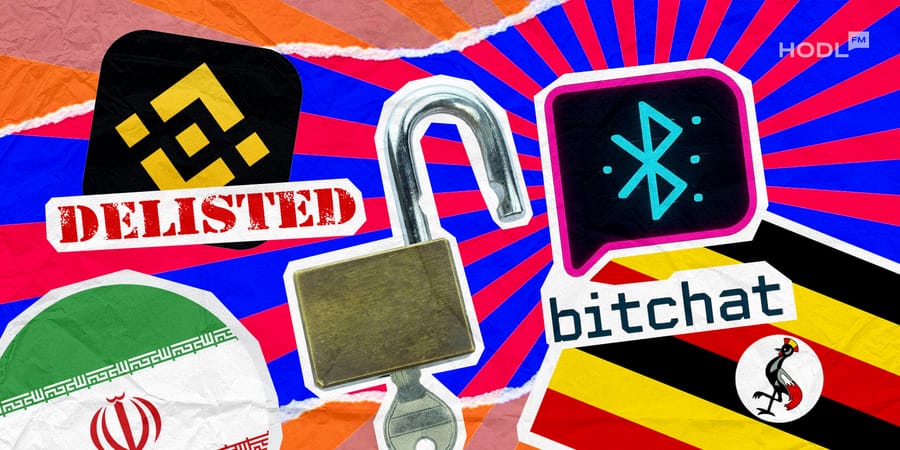


This week’s developments point to a more strained phase for crypto’s global footprint.
Exchanges are reworking liquidity arrangements, security incidents remain active, decentralized tools are being adopted in politically sensitive environments, and governments are testing crypto for purposes that extend beyond financial markets.
Taken together, these moves show an industry navigating tighter limits while finding new paths to operate, though first, let's see who are this week's Top gainers and losers.
Top gainers and losers
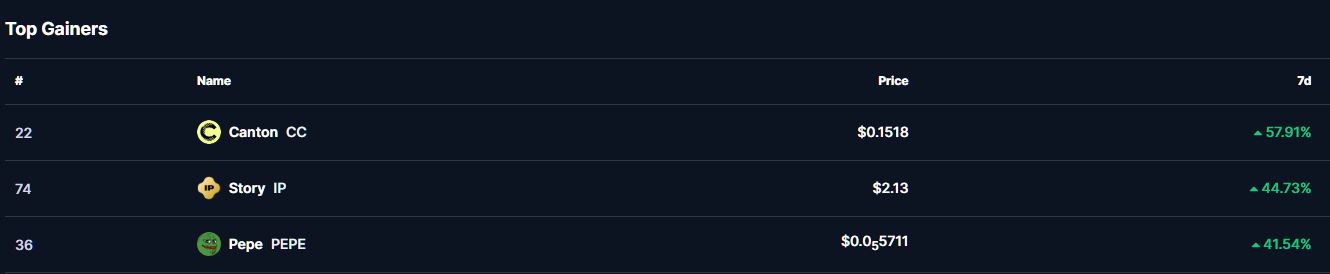
- Canton (CC) - Impressive growth of 57.91% up to the price of $0.1518
- Story (IP) - 44.73 rise to a week end price of $2.13
- Pepe (PEPE) - Weekly rise of 41.54% with end price of $0.055711

- Sku (SKY) - Loss of 9.65% down to a price of $0.06248
- Flare (FLR) - 6.33% drop to a price of $0.01061
- Mantle (MNT) - With an end price of $0.9888 and weekly loss of 5.19%
Binance to delist FDUSD pairs for BCH, AVAX, LTC, SUI, ADA, LINK and TAO
Binance will remove several trading pairs linked to the First Digital USD (FDUSD) stablecoin on Jan. 6, affecting Bitcoin Cash, Bittensor’s TAO, Avalanche, Litecoin, Sui, Cardano, and Chainlink, according to a company statement.
The delisting applies to both spot and margin markets, including cross-margin and isolated margin pairs. Binance did not disclose the reason for the decision. The exchange said users can no longer move assets tied to the affected pairs into isolated margin accounts through manual transfers or Auto-Transfer Mode. Accounts with open liabilities may manually transfer amounts only up to their outstanding obligations, adjusted for available collateral.
FDUSD is the common element across all pairs scheduled for removal. Price movement across the affected tokens has remained limited since the announcement.
Roughly a week earlier, Binance expanded spot trading for Cardano and several other assets, though the service was unavailable in jurisdictions such as the United States, Canada, Cuba, Iran, and the Netherlands. That listing update was followed by short-term price gains. Earlier delistings have produced more visible reactions.
In December, Binance said it would remove StaFi, REI Network, and Voxies, after which prices declined. In October, the exchange ended support for Flamingo, Kadena, and Perpetual Protocol, with Kadena’s valuation falling soon after.
Bitchat usage climbs in uganda ahead of 2026 election
Interest in Jack Dorsey backed messaging app Bitchat has risen sharply in Uganda as the country moves toward its 2026 general election.
Google Trends data shows a spike in searches for “Bitchat” in recent days, alongside related queries such as “bitchat apk,” “bitchat mesh,” and “how to use bitchat,” all marked as breakout terms. The app relies on Bluetooth mesh networking, allowing nearby smartphones to exchange encrypted messages without internet access, SIM cards, or centralized servers. Each device acts as a relay, with messages stored locally rather than on a central backend.
Bitchat has previously gained traction in countries facing political unrest and connectivity restrictions, including Nepal, Madagascar, and Indonesia. In Uganda, attention increased after opposition leader Bobi Wine encouraged supporters to install the app, warning of a potential internet shutdown similar to those imposed during the 2016 and 2021 elections.
Download data from Chrome-Stats shows more than 32,000 new installations over the past week, including more than 4,000 in the last 24 hours.
Wallet drain hits hundreds across EVM chains as the attack continues
Hundreds of crypto wallets are being drained across multiple EVM-compatible chains, with the attack still ongoing and its entry point still unknown, according to onchain investigator ZachXBT.
Posting on his Telegram channel, ZachXBT said the attacker is targeting a large number of wallets for relatively small amounts, usually under $2,000 per address. Although the individual losses are limited, the total stolen has reached about $107,000 so far, with activity still being observed.
The method used to compromise the wallets has not been identified, and no individual or group has been publicly named. ZachXBT has flagged one address believed to be linked to the activity:
0xAc2e5153170278e24667a580baEa056ad8Bf9bFB.
The wallet drain follows a series of security incidents reported in recent weeks. Blockchain security firm PeckShield recorded around 26 major crypto exploits in December, with estimated losses of $76 million, down from roughly $194 million in November. One of the more visible cases involved Trust Wallet, which disclosed a security issue linked to a specific version of its browser extension during the Christmas period, resulting in about $7 million in losses. The company has since begun compensating affected users and released an updated extension to support verification during the reimbursement process.
Iran signals openness to crypto payments in weapons exports
Iran is prepared to accept cryptocurrency payments in the sale of weapons and military equipment as it looks for ways to bypass international sanctions, according to a report by the Financial Times.
The Ministry of Defence Export Center, known as Mindex, has indicated it is willing to negotiate contracts that allow payment in digital currencies, alongside barter arrangements and transactions in Iranian rials. The policy was first introduced in 2025 and represents one of the clearest public signals from a state-backed arms exporter that crypto could be used in weapons trade.
Mindex operates as Iran’s overseas defense sales arm and reportedly maintains commercial relationships with buyers in 35 countries. Its official website advertises a range of military products, including missiles, rockets, ammunition, naval vessels, and hovercrafts.
The move comes as Iran remains subject to broad sanctions imposed by the United States, the United Kingdom, and the European Union. These measures target Iran’s missile and nuclear programs, energy exports, and access to the global banking system, pushing the country toward alternative settlement methods. In recent years, barter trade and digital assets have played a larger role. In December, the U.S. sanctioned 29 vessels linked to what it described as a “shadow fleet” used to transport Iranian oil.
Mindex states on its website that sanctions do not prevent contract execution, citing Iran’s broader policy of sanction circumvention. The country has previously relied on crypto-linked networks for trade. In September, the U.S. Treasury said two Iranian nationals helped facilitate more than $100 million in bitcoin and other digital asset transactions tied to Iranian oil sales between 2023 and 2025, activity officials described as part of a wider financial shadow system.
 Gunel Ismayilova
Disclaimer: All materials on this site are for informational purposes only. None of the material should be interpreted as investment advice. Please note that despite the nature of much of the material created and hosted on this website, HODL FM is not a financial reference resource, and the opinions of authors and other contributors are their own and should not be taken as financial advice. If you require advice. HODL FM strongly recommends contacting a qualified industry professional.