



Across Asia and North America, crypto is entering a more controlled phase.
Regulators are drawing firmer boundaries, while companies adapt through licensing moves, balance-sheet decisions, and closer coordination with the state.
This week’s developments point to a market where growth increasingly depends on regulatory footing rather than speed alone.
Top gainers and losers
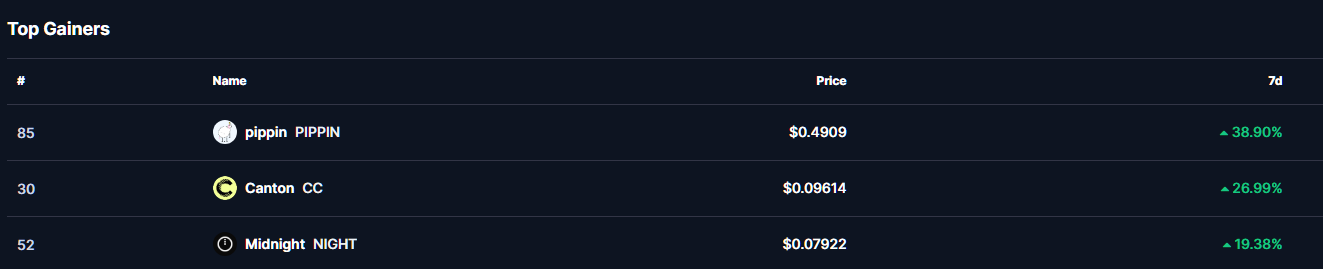
- pippin PIPPIN - Raised 38.90% this week to a price of $0.4909, good result
- Canton (CC) - 26.99% growth, to a price of $0.09614
- Midnight (NIGHT) - 19.38% rise to a price of $0.07922

- Aave (AAVE) - 14.00% loss to an end price of $156.41 this week
- Story (IP) - drop of 9.95% with end week price of $1.48
- Pump.fun (PUMP) - 9.77% drop to the end week price of $0.001788
Indonesia formalizes crypto access with official platform whitelist
The Financial Services Authority (OJK) has released a whitelist of 29 licensed digital asset and crypto trading platforms, naming both the registered entities and their associated apps or services.
The list is intended as a public reference point, allowing users to verify whether a platform is legally authorized before trading. OJK has advised investors to transact only with listed providers and to treat unlisted platforms as unlicensed.
The clarification arrives as global crypto firms seek regulated entry into Indonesia. Robinhood recently signed agreements to acquire local brokerage Buana Capital and licensed digital asset trader PT Pedagang Aset Kripto, securing a pathway into a market the company says includes more than 19 million capital-market investors and around 17 million crypto traders.
In September, Hong Kong–based OSL Group completed its acquisition of licensed local exchange Koinsayang, gaining approval to offer spot and derivatives trading.
The whitelist follows the introduction of OJK Regulation No. 23/2025, which tightened oversight of digital financial assets earlier this year. The rules prohibit exchanges from facilitating trades in unregistered or unapproved assets and establish a formal framework for crypto-related derivatives. Under the regulation, derivatives products require prior approval at the exchange level, margin must be handled through segregated funds or digital assets, and retail users must pass a knowledge assessment before accessing such products.
Indonesia’s stricter licensing regime comes as the country remains one of the world’s most active crypto markets. Chainalysis’ 2025 Global Crypto Adoption Index ranks Indonesia in the global top ten, pointing to sustained growth in user participation and transaction activity. With clearer boundaries now in place, the market’s next phase appears set to favor licensed operators with the regulatory capacity to scale.
Matador gets regulatory approval to fund Bitcoin treasury expansion
Matador Technologies has secured approval from Canadian regulators to raise fresh capital as it pushes ahead with plans to build a sizable Bitcoin treasury.
The Ontario Securities Commission has authorized the company to sell up to 80 million Canadian dollars ($58.4 million) in securities over a 25-month period. Matador said the proceeds may come from common shares, warrants, subscription receipts, debt instruments, or structured units, giving it flexibility in how the capital is raised.
The stated goal is to support its ambition of holding 1,000 Bitcoin by the end of 2026.
Matador Technologies Secures CAD $80M Base Shelf to Boost Bitcoin Growth 💰✅
— Matador Technologies (@buymatador) December 23, 2025
The Shelf Prospectus allows Matador to distribute up to CAD $80M of shares, warrants, or subscription receipts over 25 months, supporting its capital markets strategy and long-term goal of maximising…
Matador Announcement.
Chief executive Deven Soni said the company is focused on growing “Bitcoin per share” over time, framing the treasury strategy as a long-term allocation rather than a short-term trade.
Matador currently holds 175 Bitcoin, valued at roughly $15.3 million, according to BitcoinTreasuries.NET, placing it among the smaller but growing group of corporate Bitcoin holders.
Market reaction to the announcement was muted. Shares of Matador (MATA) closed Tuesday down 3.57%, a reminder that equity investors remain cautious about balance-sheet crypto exposure amid ongoing volatility. Chief visionary Mark Voss said the company plans to deploy capital selectively, taking market cycles into account rather than buying on a fixed schedule.
Matador’s plans unfold in a more crowded corporate landscape. More than 190 publicly traded companies now hold Bitcoin, a number that has risen steadily since spot Bitcoin exchange-traded funds launched in the United States last year. The trend has brought both visibility and scrutiny. Several firms that embraced Bitcoin treasuries during the rally have since seen their share prices slide as crypto markets cooled.
In some cases, balance-sheet pressure has forced companies to reverse course. Semiconductor maker Sequans sold 970 Bitcoin in early November to redeem convertible debt, stepping back from its previously stated accumulation plans. Against that backdrop, Matador’s approach highlights the challenge facing smaller treasury-focused firms: scaling holdings while managing dilution, volatility, and investor expectations.
Matador entered the Bitcoin treasury space a year ago, on Dec. 23, 2024, alongside its core business of building products that help traditional financial firms access the Bitcoin ecosystem. The latest fundraising approval gives it regulatory room to pursue that strategy, though execution will depend heavily on market conditions over the next two years.
Binance lists som-pegged stablecoin as Kyrgyzstan expands crypto ambitions
Kyrgyzstan has added another piece to its growing digital asset framework, with its newly launched som-pegged stablecoin securing a listing on Binance.
President Sadyr Japarov said this week that the KGST stablecoin, which is tied to the Kyrgyz som, is now available on the exchange.
Writing on X, Japarov described the listing as a step toward improving cross-border payments and strengthening Kyrgyzstan’s engagement with crypto-based financial infrastructure.
Greetings everyone!
— Sadyr Zhaparov (@sadyrzhaparovkg) December 24, 2025
Today I received important and truly landmark news — the Kyrgyz stablecoin KGST has been listed on the global cryptocurrency exchange Binance @binance. KGST @KGSToken is backed 1:1 by the national currency of the Kyrgyz Republic, the som.
I congratulate the… pic.twitter.com/U8dNPsKA6y
Binance founder Changpeng “CZ” Zhao responded publicly, saying the exchange expects to support additional government-backed stablecoins in the future.
Zhao has advised Kyrgyz authorities since April under an agreement covering technical support and policy consultation.
The listing follows a series of policy moves that signal a more assertive national crypto strategy. Kyrgyzstan, a landlocked Central Asian country with a population of around seven million, has spent the past year laying legal and operational groundwork for digital assets. In September, lawmakers advanced legislation aimed at creating a state crypto reserve and supporting the development of a domestic digital asset sector.
Alongside KGST, the country recently launched USDKG, a U.S. dollar–pegged stablecoin backed by physical gold. The token debuted on the Tron blockchain with an initial supply of 50 million units, with plans to expand issuance to Ethereum as the project matures.
Offchain Labs adds to ARB holdings as Arbitrum tops $20B in value secured
Offchain Labs has increased its holdings of ARB, the governance token of the Arbitrum network, at a time when prices across the governance-token segment remain under pressure and competition among Ethereum layer-2s continues to intensify.
Offchain Labs is committed to growing the Arbitrum ecosystem in a meaningful way, and we believe that it is in our best interests to continue increasing our direct exposure. As such, we have purchased additional $ARB in accordance with an enacted purchase plan. Through these…
— Offchain Labs (@Offchain) December 24, 2025
Offchain Labs Official Post.
In a post shared this week, the Arbitrum developer said it has added to its direct ARB exposure under an existing, approved purchase plan. Offchain Labs described the move as part of a longer-term commitment to building the network, signaling confidence despite weaker sentiment across much of the sector. ARB has struggled alongside other governance tokens as investors reassess their utility and revenue capture.
Arbitrum is an Ethereum layer-2 scaling network that relies on optimistic rollups, processing transactions off-chain before settling them on Ethereum. The design aims to reduce fees and increase throughput while retaining Ethereum’s security guarantees. Within that system, ARB serves as a governance token, giving holders voting power over protocol upgrades, treasury spending, and ecosystem initiatives. Network revenues accrue onchain to a treasury controlled by tokenholders rather than directly to the developer.
The timing of Offchain Labs’ purchase coincides with new network milestones. Arbitrum said its flagship Arbitrum One rollup has processed more than 2.1 billion lifetime transactions, and that total value secured on the network surpassed $20 billion in 2025, keeping it the largest Ethereum layer-2 by that measure. Rival networks such as Optimism and Base have seen rapid application growth but report lower levels of value secured. Base, which operates without a native token, remains the subject of market debate over whether that could change.
As Ethereum’s roughly $68 billion DeFi market becomes more competitive, Arbitrum’s scale has given it an advantage in liquidity and activity. Offchain Labs’ decision to add to its ARB position suggests the team is willing to maintain exposure to its own governance token, even as questions persist across the industry about how such tokens ultimately sustain value.
 Oleksii Shumak
Disclaimer: All materials on this site are for informational purposes only. None of the material should be interpreted as investment advice. Please note that despite the nature of much of the material created and hosted on this website, HODL FM is not a financial reference resource, and the opinions of authors and other contributors are their own and should not be taken as financial advice. If you require advice. HODL FM strongly recommends contacting a qualified industry professional.