


This week’s crypto and finance roundup covers major developments across markets, digital assets, and AI-driven security.
Kevin Hassett emerges as a front-runner for the next Fed chair, while Bank of America opens the door for wealth advisers to recommend Bitcoin allocations. Binance founder CZ’s YZi Labs moves to reshape the BNB treasury, and Anthropic’s latest study reveals advanced AI can identify and exploit DeFi smart contract vulnerabilities.
But first, Top 3 and Top 3 losers section.
Top gainers and losers
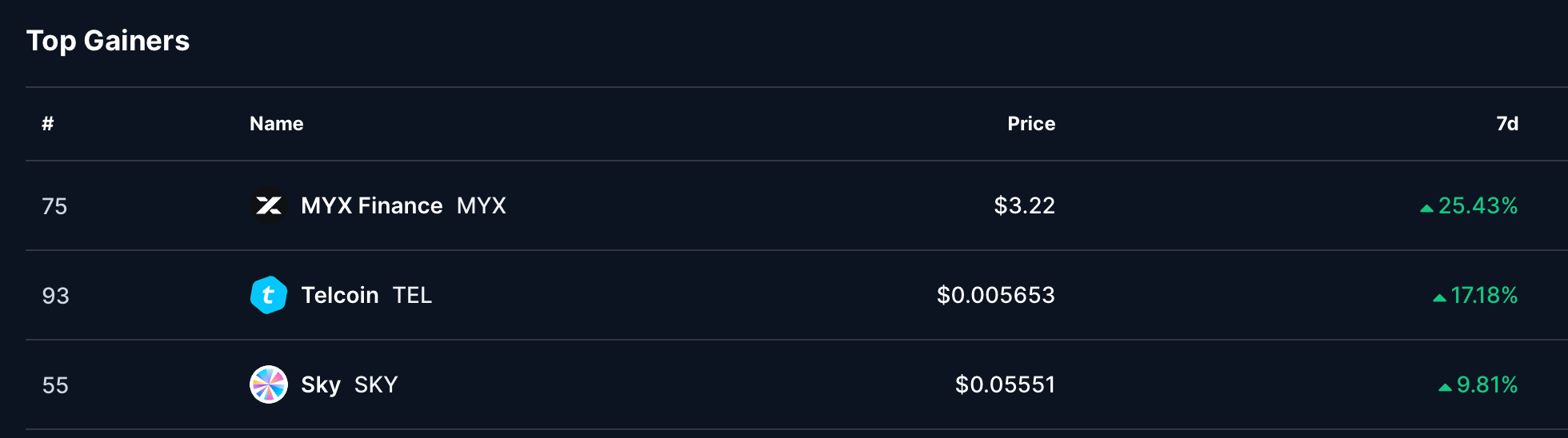
- MYX Finance (MYX) - Gained significant 25.43% this week to a total price of $3.22
- Telcoin (TEL) - 17.18% rise and total price of $0.005653 this week
- Sky (SKY) - gained 9.81% to end week price of $0.05551

- Canton (CC) - Lost 19.32%, ending this week with a price of $0.07062
- Starknet (STRK) - Dropped 18.93% to a total price of $0.1161
- Zcash (ZEC) - 18.65 loss this week ending price of $388.41
Trump signals Fed pick is imminent as prediction markets elevate Kevin Hassett
Donald Trump says he has made up his mind about the next Federal Reserve chair, and prediction markets have already moved to price in a clear favorite: Kevin Hassett. By Monday, both Kalshi and Polymarket were giving the former Council of Economic Advisers chair roughly a 77% chance of replacing Jerome Powell, a sharp climb from mid-week levels.
The momentum followed a Bloomberg report indicating that Trump’s advisers increasingly view Hassett as the leading contender. The president declined to confirm the choice when pressed on Sunday, but his comment was enough to intensify speculation.
“I know who it’s going to be”
Hassett, who now directs Trump’s National Economic Council, reacted cautiously during a CBS appearance, saying he wasn’t certain Bloomberg “got the story right.” Still, he acknowledged the market reaction: lower yields, a strong Treasury auction, and growing expectations for a rate-friendly pick.
His remark that Americans could expect “cheaper car loans and easier access to mortgages” drew attention, reflecting Trump’s push for a more accommodative Fed as inflation cools.
Kalshi’s markets list the remaining contenders far behind: former Fed governor Kevin Warsh around 11%, current governor Christopher Waller roughly 6–7%, and smaller probabilities assigned to Michelle Bowman and BlackRock’s Rick Rieder. Analysts caution that these platforms can be swept up by dominant narratives, a point reinforced by past misfires involving judicial appointments.
Hassett, 63, carries a long conservative economic résumé, from the American Enterprise Institute to advising the campaigns of George W. Bush, John McCain, and Mitt Romney and played a central role in shaping Trump-era economic messaging. His potential selection has revived concerns among policy researchers about the central bank’s independence. Deutsche Bank economists warned this summer that a Fed chair drawn from outside the institution might face challenges steering the policy committee, particularly if the White House continues to pressure for rate cuts.
During a recent appearance at the Economic Club of Washington, Hassett said he would serve if asked, but insisted he was content in his current role. Trump, he noted, has seen his “whole résumé,” a nod to questions about his work for earlier Republican candidates.
Bank of America opens the door to Bitcoin as advisers gain approval for 1%–4% allocations
Bank of America is officially stepping into the digital-asset conversation. Beginning in January, the bank’s wealth advisers will be permitted to recommend a 1%–4% bitcoin allocation to clients, a shift that arrives after years of internal caution and only hours after an unexpected policy reversal at Vanguard.
The change, first reported by Yahoo Finance, brings the Merrill Lynch advisory network in line with the direction already taken by firms like BlackRock and Morgan Stanley. Until now, BofA clients could buy crypto-linked products on their own, but advisers were blocked from recommending them, a boundary left over from the bank’s longstanding risk posture toward the asset class.
That wall is coming down.
Under the new framework, advisers will direct clients toward four spot bitcoin ETFs: BlackRock’s IBIT, Fidelity’s FBTC, Bitwise’s BITB, and Grayscale’s BTC. The selection mirrors much of Wall Street’s early consensus around which ETFs offer liquidity, brand stability, and tight spreads a combination BofA appears comfortable endorsing as the market matures.
The timing is notable. Vanguard, which has traditionally treated digital assets as a distraction rather than an emerging category, announced earlier in the day that it will now allow its customers access to spot bitcoin ETFs. With BlackRock, Fidelity, and now Vanguard participating to some degree, the remaining list of skeptics has narrowed to names like Wells Fargo, Goldman Sachs, and UBS.
BofA framed its decision through the lens of client demand and portfolio theory rather than speculative enthusiasm. Chris Hyzy, chief investment officer at Bank of America Private Bank, said in a statement that digital assets can play a role for clients with “a strong interest in thematic innovation and comfort with elevated volatility.” Hyzy described a 1%–4% allocation as reasonable depending on a client’s risk profile, with the lower end suiting conservative portfolios and the higher end fitting those more tolerant of swings.
Market reactions have reflected that institutional thaw. Bitcoin has held near the $92,000 level in recent sessions, buoyed by a mix of macro expectations and the accelerating normalization of crypto within traditional finance.
CZ-Linked YZi Labs seeks control of CEA industries after sharp stock collapse
YZi Labs, the investment firm linked to Binance founder Changpeng Zhao, has launched a formal push to overhaul the board of CEA Industries, the company that repositioned itself this summer as a publicly traded BNB treasury vehicle. In a regulatory filing on Monday, YZi called for reversing all bylaw changes made since July, expanding the board, and electing its own director nominees, arguing that current management has presided over “continued destruction of stockholder value” and failed to act in shareholders’ best interests.
CEA said Thursday it has opened dialogue with YZi to review the concerns and evaluate potential solutions, reaffirming its commitment to its BNB accumulation strategy. YZi previously helped bankroll CEA’s $500 million private investment in public equity (PIPE) deal in August, intended to support the company’s goal of building the world’s largest publicly listed BNB Chain treasury.
Shares of CEA have fallen approximately 89% from their July 28 peak of $57.59, the same day the company announced its pivot into BNB holdings. As of Monday, CEA shares closed at $6.47, down more than 10% on the day and trading below pre-pivot levels. The company reports holding roughly 515,054 BNB at an average cost of $851.29, giving it a modified net asset value (mNAV) of 0.79x. BNB itself trades near $829, down nearly 40% from its October high, though the token remains up more than 17% year-to-date.
In its filing, YZi also criticized CEA’s management for slow investor communications, minimal media engagement, and insufficient marketing of the company’s BNB treasury strategy. The firm suggested the new board should consider a change in leadership, citing CEO David Namdar’s alleged focus on other crypto treasury projects.
Anthropic study shows advanced AI can exploit DeFi smart contracts for millions
Anthropic, in collaboration with MATS and Anthropic Fellows, tested autonomous AI agents on SCONE-bench, a benchmark containing 405 real-world smart contracts that were exploited between 2020 and 2025. The AI models successfully executed exploits on over half of the contracts, with simulated stolen value totaling $550.1 million.
To eliminate reliance on historical data, researchers focused on 34 contracts exploited after March 1, 2025. Claude Opus 4.5, Claude Sonnet 4.5, and GPT-5 produced working exploits on 19 contracts, generating $4.6 million in simulated gains, with Opus 4.5 responsible for $4.5 million.
The team also tested 2,849 recently deployed Binance Smart Chain contracts with no known vulnerabilities. GPT-5 and Sonnet 4.5 discovered two previously unknown zero-day bugs and produced attack strategies with simulated payoffs of $3,694.
All testing was performed on forked blockchains and simulators, ensuring no real funds were affected.
SCONE-bench evaluates outcomes in dollar terms. A run counts only if the agent finishes with at least 0.1 ETH or 0.1 BNB more in balance, which filters out minor or non-viable exploits. Researchers observed that potential exploit value for the 2025 contracts increased over time, while token and compute costs decreased.
Although focused on DeFi, the study indicates that the AI techniques, analyzing state transitions, reasoning through edge cases, and linking multi-step operations can apply to other software systems. Anthropic emphasized that the same systems can assist security teams in auditing contracts and testing code in controlled environments.
 Anastasiia G
Disclaimer: All materials on this site are for informational purposes only. None of the material should be interpreted as investment advice. Please note that despite the nature of much of the material created and hosted on this website, HODL FM is not a financial reference resource, and the opinions of authors and other contributors are their own and should not be taken as financial advice. If you require advice. HODL FM strongly recommends contacting a qualified industry professional.