




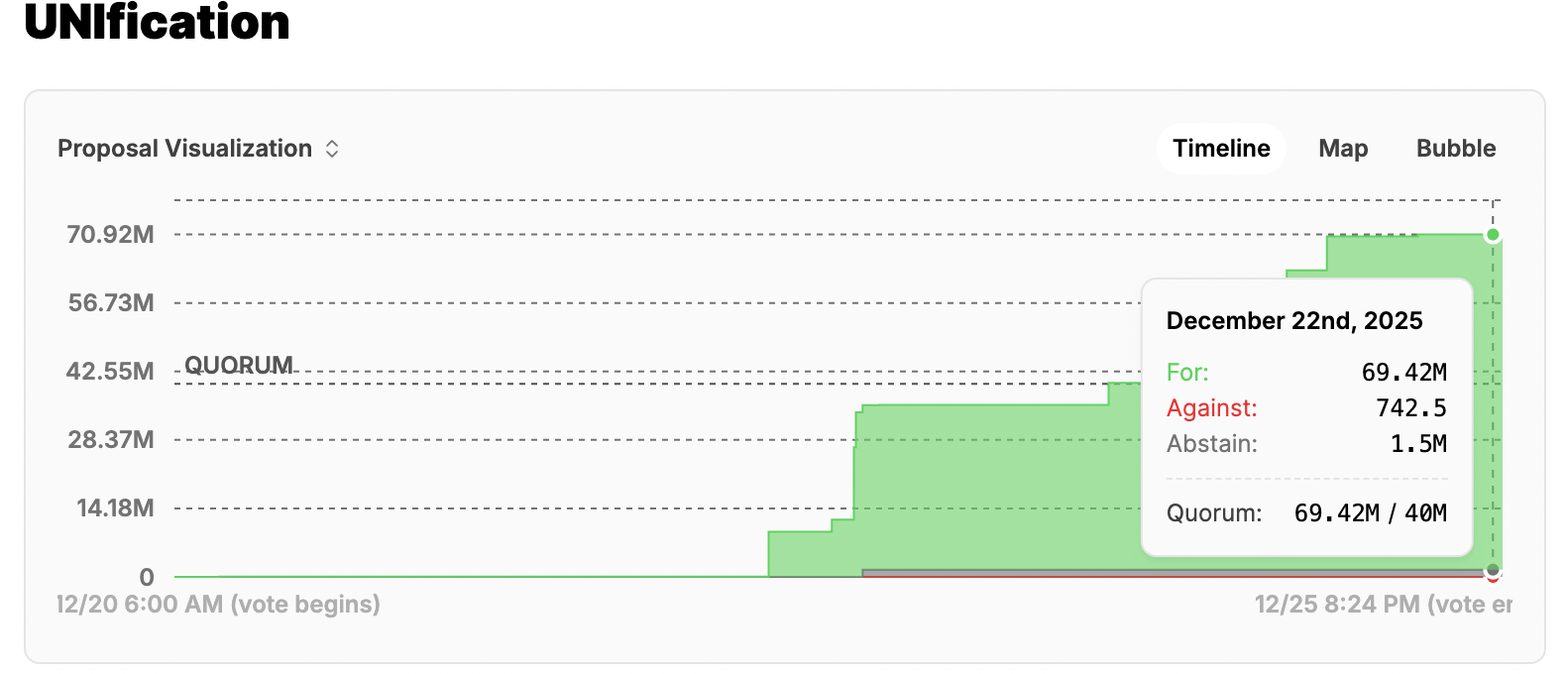
The Uniswap community has agreed to a big governance plan called "UNIfication." This is one of the biggest changes to the decentralized exchange in its seven-year history. The proposal got more than 69 million votes in favor, which is more than the 40 million needed to pass. Voting began on December 20 and is set to close on Christmas Day.
Major upgrade to align Uniswap ecosystem
The joint proposal from Uniswap Labs and the Uniswap Foundation aims to activate the protocol’s long-awaited fee switch. It establishes a model where Uniswap protocol usage directly drives UNI token burns and strengthens incentives for liquidity providers. The plan also seeks to streamline operations by consolidating Uniswap’s development and growth efforts under Uniswap Labs.
Under the new mechanism, protocol fees from Uniswap v2 and v3 pools will gradually redirect to the network’s “Firepit” smart contract, where the earned fees will be used to burn UNI tokens. A total of 100 million UNI will also be permanently removed from the Uniswap Foundation’s treasury to simulate what would have been burned if fees had been active since the beginning of the protocol.
Uniswap Labs CEO Hayden Adams wrote that the two-day timelock period following the vote will lead to the activation of the Unichain mainnet’s protocol fee switch. Once live, the change will start the automated UNI burn cycle.
Just submitted the Unification proposal for final governance vote
— Hayden Adams 🦄 (@haydenzadams) December 18, 2025
Voting starts on 12/19 at 10.30pm EST and ends on 12/25
If it passes, after a 2 day timelock period:
🔥 100m UNI will be burned
🦄 v2 + v3 fee switches will flip on mainnet and begin burning UNI, along with…
New fee mechanism and liquidity provider incentives
The UNIfication proposal introduces a fee structure designed to reward liquidity providers while securing the long-term value of UNI. For Uniswap v2 pools, fees will consist of a 0.25% liquidity provider fee and a 0.05% protocol fee. For Uniswap v3, fees vary by pool type, with initial protocol fees set at one-fourth or one-sixth of LP fees depending on pool tiers.
A new system called Protocol Fee Discount Auctions (PFDA) will auction off limited-time fee exemptions to traders. Winning bids will go directly to UNI token burns, creating a feedback loop between trading volume and UNI scarcity. Preliminary modeling suggests this incentive could improve LP returns by approximately $0.06 to $0.26 for every $10,000 in volume.
Governance and structural changes
The UNIfication plan also merges the organizational structure of the Uniswap ecosystem. Foundation staff responsible for governance, developer relations, and community growth will transition to Uniswap Labs. Meanwhile, the Foundation will focus on managing its final grant distributions before fully integrating its functions into the new structure.
To ensure alignment, Uniswap governance will establish an annual Growth Budget of 20 million UNI, distributed quarterly beginning January 2026. This funding will support protocol integrations, developer programs, and partnerships aimed at expanding Uniswap’s adoption across web3 platforms.
Governance records show that the new agreement was independently negotiated between the Uniswap Foundation and Uniswap Labs. The framework includes an explicit commitment that Labs will only pursue strategies consistent with decentralized governance and UNI holder interests.
Market reaction and token performance
The ongoing governance process has fueled a strong rally in UNI’s market price. Since voting opened, UNI has climbed roughly 27%, trading around $6.21 according to CoinGecko data. The rally helped reverse a previous slump that saw the token fall to a seven-month low of $4.88.
News of the UNIfication initiative in early November had already lifted optimism in the community, with UNI jumping from near $7 to $9.70 on November 11. The latest surge comes amid a broader market rebound that has encouraged investors to re-engage with DeFi assets.
Uniswap has processed over $4 trillion in transaction volume since its 2018 launch and remains the largest decentralized exchange by cumulative trading activity. The UNI token currently ranks as the 39th-largest cryptocurrency, with a market capitalization of about $3.8 billion.
Broad support from industry leaders
The UNIfication proposal gained backing from several influential DeFi and venture capital figures. Supporters included Jesse Walden, founder and managing partner at Variant Fund; Kain Warwick, founder of Synthetix and Infinex; and former Uniswap Labs engineer Ian Lapham.
Only 742.5 votes, or about 0.001% of the total, opposed the proposal, while 1.5 million votes abstained. The outcome underscores strong community agreement around a long-term roadmap that ties protocol growth to direct tokenomics adjustments.
What comes next
With voting results secured and the timelock in effect, the on-chain implementation of the fee switch on Unichain is expected within days. Once the update goes live, Uniswap will begin operating under its new economics and governance framework, a structure that proponents say aligns incentives between developers, liquidity providers, and token holders better than ever before.
 Anastasiia G
Disclaimer: All materials on this site are for informational purposes only. None of the material should be interpreted as investment advice. Please note that despite the nature of much of the material created and hosted on this website, HODL FM is not a financial reference resource, and the opinions of authors and other contributors are their own and should not be taken as financial advice. If you require advice. HODL FM strongly recommends contacting a qualified industry professional.