

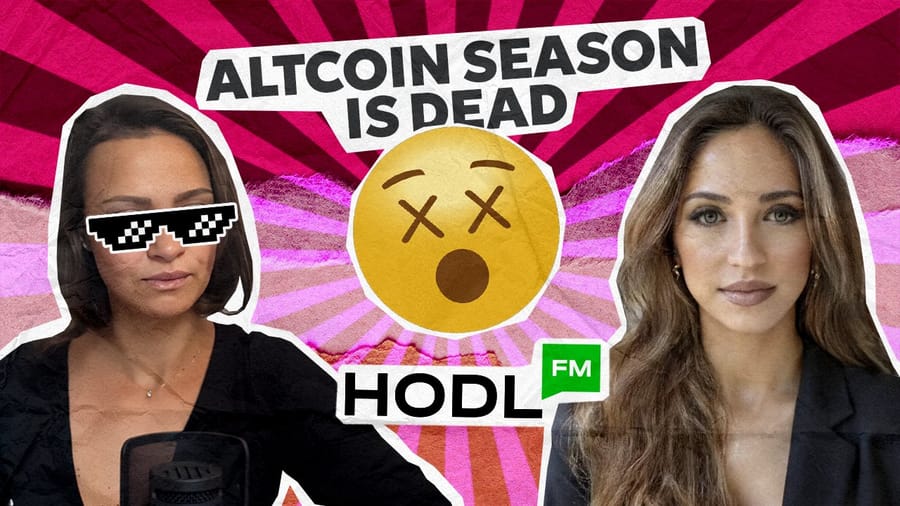


In a recent episode of HodlFM, host Tanya Petrusenko sat down with Maryna Barysheva, CEO at LKI Consulting, to discuss how the mechanics of token launches, market narratives, and investor behavior in Web3 have shifted. The conversation highlighted an emerging reality, altcoin seasons as we knew them may no longer return, and the way projects approach Token Generation Events (TGEs) has completely transformed.
“The market has changed dramatically. Bitcoin, Ethereum, and all of these top coins, stupid for not holding it! Alt season this year or maybe next year? Or should we move on from the fantasy of the alt season that we used to have?” Tanya opened.
Maryna noted that institutions, not retail traders, now shape market cycles.
“Historically, altcoin season allowed retail investors to make money with Bitcoin first and then rotate profits into alts that cycle hasn’t happened. Retail hasn’t regained capital or confidence to reinvest, so institutions dominate price action.”
LKI Consulting’s evolution
Maryna shared her path to Web3, explaining that she entered from a technology background, not trading.
“I was a non-believer in crypto, I was the person screaming ‘crypto is a scam!’ Don’t buy it,” she said.
Before crypto, she worked in payments, fintech, and even gaming. She later helped scale a Lithuanian startup from 30 to 330 people with a $100 million valuation.
At LKI Consulting, a decade-old agency, the work now splits across two divisions.
“The retail division, helping projects go to market and launch tokens. The corporate division, focused on digital asset strategies and market expansion, primarily in the UAE region,” Barysheva explained.
Over 260 projects have partnered with the firm, navigating a market moving from ICO chaos toward institutional discipline.
Narratives have shortened — alignment now drives growth
Maryna emphasized that the concept of “narratives” has changed. During previous bull runs, influencers could post a list of trending sectors, “It’s AI season!”, and dozens of tokens would rally. Now, those cascades have weakened.
“The lifecycle of a narrative has shortened, before, one narrative lasted two or three years; now, it’s more like three months,” she said. According to her, “Today it’s not a call for a narrative, it’s a call for alignment. Alignment with what institutions require: cross-border payments, DATs, and other tools that large organizations can adopt.”
Revenue has also become central to the story.
“We’ve had too many vanity metrics, claiming one million users on a $17k MRR,” she added.
Projects that survive must combine institutional integration with proven business models, not just hype.
TGEs shift from retail dependence to institutional backing
The podcast explored why traditional TGEs and launchpads struggle.
“A TGE, Token Generation Event, is still necessary if you’re issuing a token. But whether projects raise through public rounds or private listings on DEXs or CEXs is a separate question,” Maryna explained.
She noted how launchpads that offer refund guarantees damage price stability. “They tried to fix failed token launches by offering 100% refund policies, completely unsustainable! This created artificial sell pressure,” she said.
Exchanges also changed their gatekeeping.
“Traditional top exchanges won’t take you unless you’ve done a public round via launchpads. That creates a closed-loop problem, how to launch without spending $2 million in listing fees or forced trading volume,” she added.
As a result, many projects now start on decentralized exchanges.
“You control liquidity, test token behavior, and only move to CEXs once price stability is proven,” she said.
Marketing tokens to followers, users, and traders
Maryna stressed that tokens alone no longer guarantee success. “A token is not a product strategy, nor a business strategy,” she said. To succeed, projects must develop either a working product that solves a real pain point or a token deeply integrated into an ecosystem “so that people feel, frankly, stupid for not holding it.”
She outlined three distinct audiences: followers, users, and traders.
“Followers want entertainment and community. Users want their problems solved. Traders want to make money. If your marketing doesn’t speak to all three, you won’t stand out.”
The new playbook for TGEs and Web3 success
A successful TGE now rests on three pillars:
“Sound tokenomics, incentives, unlocks, and structure that make financial sense. A real product, innovation that adds value. Sustainable buy pressure, knowing where it’s coming from,” she said.
Maryna also urged founders to prepare multiple scenarios post-launch. “Too many founders plan for launch day only. You must prepare optimistic, moderate, and pessimistic scenarios.”
As for altcoin seasons, she believes they belong in the past.
“We need to move on from the fantasy of alt season as we knew it. The market has changed dramatically due to institutional participation. Volatility will be lower, that’s how institutions like it.”
Now might be the best moment to build:
“Blockchain was meant to be a foundational technology for real products, not just tokens.”
 Tanya Petrusenko
Disclaimer: All materials on this site are for informational purposes only. None of the material should be interpreted as investment advice. Please note that despite the nature of much of the material created and hosted on this website, HODL FM is not a financial reference resource, and the opinions of authors and other contributors are their own and should not be taken as financial advice. If you require advice. HODL FM strongly recommends contacting a qualified industry professional.