






Bitcoin extended losses on Tuesday, falling 3.9% to about $87,895, its lowest level since Jan. 9, as macro pressure from geopolitics and bond markets swept through risk assets. The decline marked a sharp reversal from earlier January strength and placed renewed focus on Bitcoin’s sensitivity to global liquidity conditions.
Losses accelerated across the broader crypto market. Ether dropped more than 7%, while Solana fell 5%. According to TradingView data, Bitcoin has now erased all gains made this year and sits roughly 10% below its year-to-date high near $98,000.
Political shock rattles risk sentiment
The sell-off followed renewed volatility across traditional markets after President Donald Trump’s latest foreign policy remarks. Trump reiterated plans to assert U.S. control over Greenland, comments that revived fears of a fractured transatlantic alliance and added strain to already fragile global sentiment, Bloomberg reported.
Markets also reacted to Trump’s renewed tariff threats toward Europe, which triggered a return of the so-called “Sell America” trade seen after similar announcements last April, according to Reuters. Investors moved quickly to reduce exposure to volatile assets, with crypto among the first to absorb pressure.
Despite debate over the precise catalyst, the timing aligned closely with sharp moves in sovereign debt markets, particularly in Japan, which amplified global risk aversion.
Japanese bond turmoil tightens global liquidity
Japan’s bond market delivered one of its most violent moves in decades. Yields on 30- and 40-year government bonds surged more than 25 basis points, while 10-year yields climbed nearly 19 basis points in just two days. Reuters reported that 30-year yields posted their largest daily jump since 2003.
The move followed comments from Prime Minister Sanae Takaichi, who pledged tax cuts as part of her election campaign. Investors reacted to expectations of looser fiscal policy, heavier government spending, and reduced liquidity.
Dan Tapiero, founder and CEO of 50T Funds, attributed the crypto drawdown to events in Japan, saying the “wipeout” was caused by “complete annihilation in Japanese bond markets infecting all markets right now.”
Wipeout.
— Dan Tapiero (@DTAPCAP) January 20, 2026
Complete annihilation in Japanese bond mkts infecting ALL markets right now.
This is what discontinuity/dysfunctionality of a mkt looks like.
Authorities will attempt to step in to smoothe.
Bessent aware.
Yen going down a lot more.
Gold up, btc eventually follows. pic.twitter.com/jiQEdQgCLX
U.S. Treasury Secretary Scott Bessent echoed the view.
“I believe markets are going down because the Japanese bond market had a six-standard-deviation move over the past two days,” he said. “This has nothing to do with Greenland.”
Liquidations accelerate as support levels fail
Market structure worsened as Bitcoin fell below its 50-day exponential moving average, which had acted as support during the recent rally.
Over the past 48 hours, more than $1.8 billion in crypto positions faced liquidation, with roughly 93% tied to long exposure, according to CoinGlass. Total crypto market capitalization declined by $225 billion, its steepest drop since mid-November, leaving the sector valued at about $3.08 trillion.
On-chain data pointed to cooling momentum. CoinGlass’ net realized profit and loss metric slipped into slightly negative territory after months of gains, which suggested fading buying pressure as sellers took control.
Institutional buying offers limited relief
Amid the turbulence, Strategy disclosed a $2.13 billion Bitcoin purchase completed over the past eight days, its largest accumulation since July. The company, led by long-time Bitcoin advocate Michael Saylor, provided a rare signal of institutional conviction during the drawdown.
However, the buying failed to offset broader market stress. Without fresh inflows, Bitcoin remains vulnerable to further downside. Traders now watch the $97,000–$98,000 zone as a key recovery level, while a sustained break below $90,000–$91,000 raises the risk of a deeper pullback.
Tentative stabilization follows forced selling
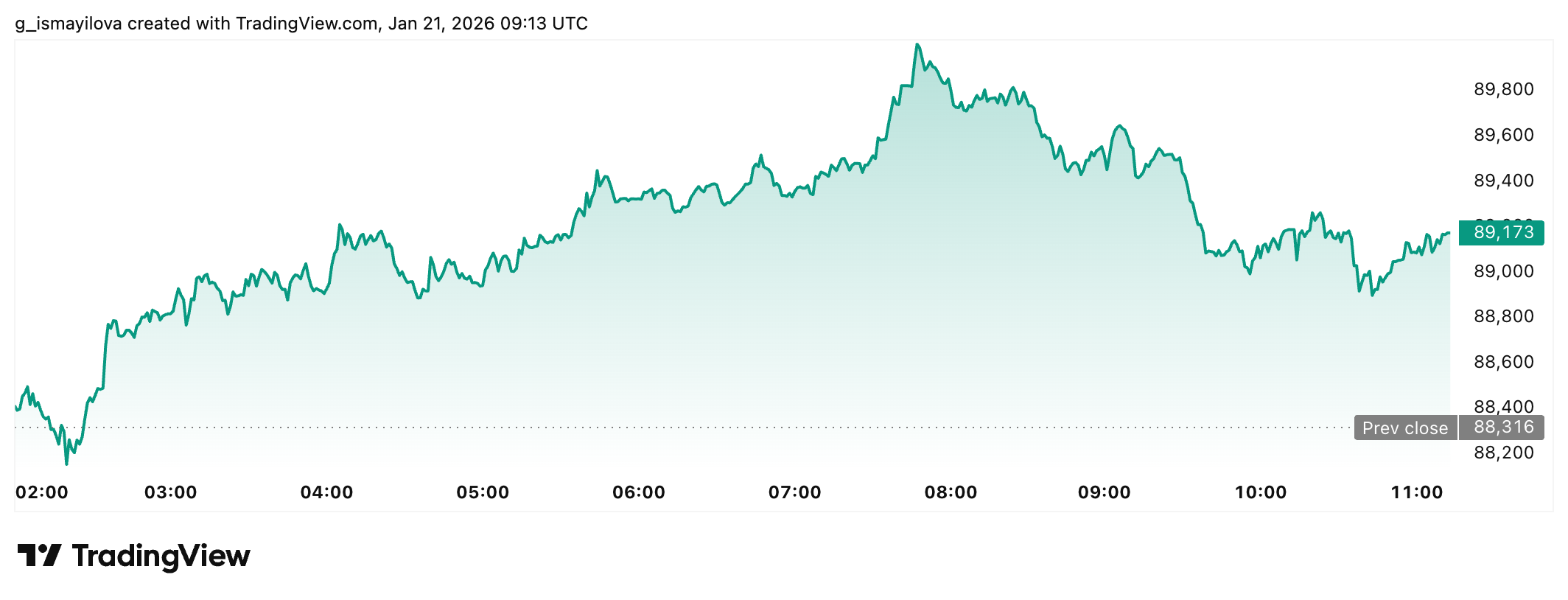
By Wednesday, crypto prices showed early signs of stabilization. Bitcoin hovered near $89,600, off the session lows, while Ether and major altcoins pared part of their losses. The pause followed a rebound in Japanese government bonds after officials urged calm, easing pressure across global markets.
U.S. equity futures edged higher, signaling a break from the panic-driven selling. Gold and silver continued to trade near record highs, which reflected persistent defensive positioning.
The stabilization came ahead of Trump’s scheduled appearance at the World Economic Forum in Davos, his first visit since 2020. Markets remain cautious as investors assess whether macro stress subsides or resurfaces.
For now, Bitcoin stands at a crossroads. Weak technical signals, heavy liquidations, and unresolved macro risk continue to shape near-term direction, with volatility likely to remain elevated.
 Oleksii Shumak
Disclaimer: All materials on this site are for informational purposes only. None of the material should be interpreted as investment advice. Please note that despite the nature of much of the material created and hosted on this website, HODL FM is not a financial reference resource, and the opinions of authors and other contributors are their own and should not be taken as financial advice. If you require advice, HODL FM strongly recommends contacting a qualified industry professional.