






The term hash rate often comes up when people talk about mining. While “rate” hints at speed, hash rate is much more than that. It’s the heartbeat of Bitcoin’s mining ecosystem and the force that keeps the entire network secure.
This article breaks down what hash rate is, how it works, why it matters, and how it affects both everyday miners and institutional investors.
What is the hash rate?
A bit of motivation to start with. In November 2025, a solo Bitcoin miner managed to capture 3.146 BTC (plus fees), worth about $270,000, using nothing more than a 6 TH/s ASIC. That’s only ~0.0000007% of the entire network hash rate. His odds of finding a block at that speed were roughly 1 in 180 million (!)
This story will help illustrate what hash rate is and the role it plays in Bitcoin mining.
Hash rate sits at the core of how Bitcoin is mined. Bitcoin relies on a system called proof-of-work, where miners compete to add the next block to the blockchain. To do this, their machines make billions of tiny guesses every second, trying to solve a mathematical puzzle.
Each guess is called a hash. And the hashrate tells us how many guesses the entire network makes per second.
There is the hash rate of every individual solo miner, and the network-wide hash rate. In the picture below, you can see the current overall network hash rate.
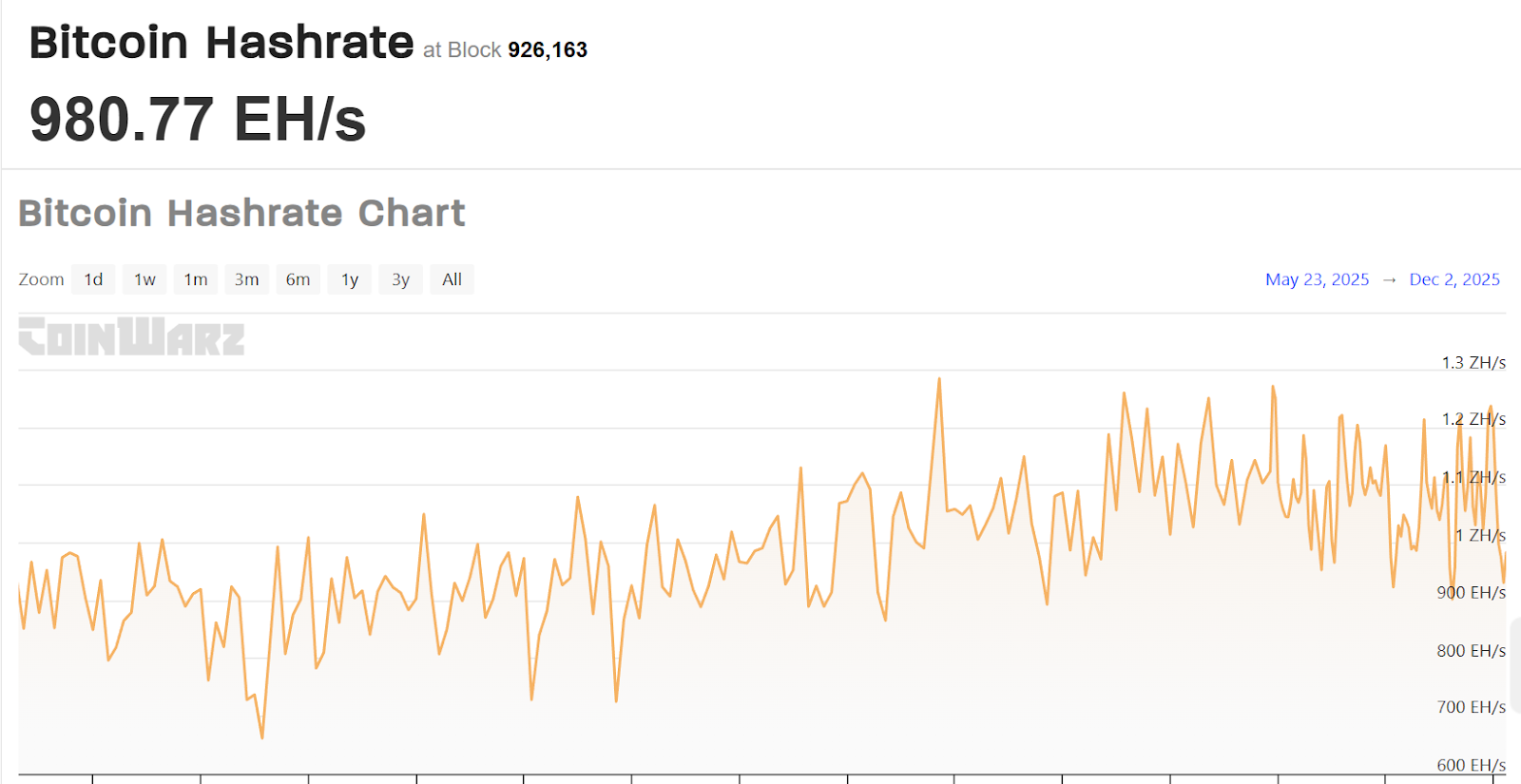
How hash rate works
The only way to find a valid hash is by guessing over and over again. More hash rate means miners find solutions faster. Bitcoin expects this and automatically adjusts difficulty. So even if miners suddenly become 10× stronger, Bitcoin reacts by making the puzzle 10× harder. As a result, blocks still come every ~10 minutes.
Difficulty adjusts every 2,016 blocks, which is roughly 2 weeks. This window is long enough to smooth out short-term fluctuations but short enough to react to real changes in mining power.
Bitcoin checks how long the last 2,016 blocks took. If miners are too fast, the difficulty increases. If they are too slow, the difficulty decreases.
Even if blocks were coming in every 7 minutes or every 15 minutes temporarily, the next adjustment brings it back to the 10-minute target. This is why Bitcoin stays predictable even when miners enter or leave the network.
How is the hash rate calculated?
BTC hash rate is essentially an estimate of how much computational power is mining Bitcoin at any given moment. The network uses two key signals to calculate it: how quickly blocks are being found and the current mining difficulty. Since Bitcoin aims for one block every 10 minutes, faster block times suggest a higher hash rate and slower times indicate the opposite.
There’s a standard formula that helps us roughly calculate it using block times and difficulty:
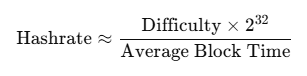
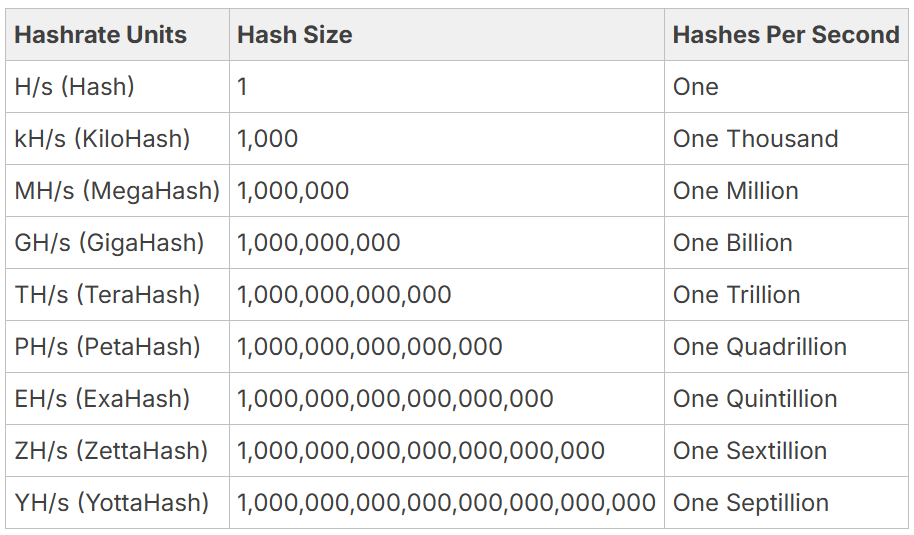
The BTC hashrate is typically calculated as hashes per second (h/s). The hash unit can be expressed by size:
Why hash rate matters
Hash rate is one of the clearest indicators of Bitcoin’s overall health and stability. It reflects the network’s security and the mining difficulty. It’s like a powerful fan spinning very fast: if someone tries to throw small stones into it, they just bounce off. The same happens with Bitcoin: when the hash rate is high, attackers are easily pushed back.
What's a 51% attack?
A 51% attack happens when one person or a coordinated group controls more than half of the entire network’s mining power. With that majority, they could rewrite recent transactions, reverse payments, or block new ones from being confirmed.
If an attacker controls over 50% of the Bitcoin hash rate, they can mine blocks faster than the rest of the network combined. This allows them to create a private version of the blockchain—a “fork.” If they keep mining on their fork and eventually make it longer than the honest chain, the network is forced to accept it as the real history.
A successful attack could enable double-spending, damage user trust, and shake Bitcoin’s credibility as a decentralized system. It undermines the very foundation of blockchain: immutability.
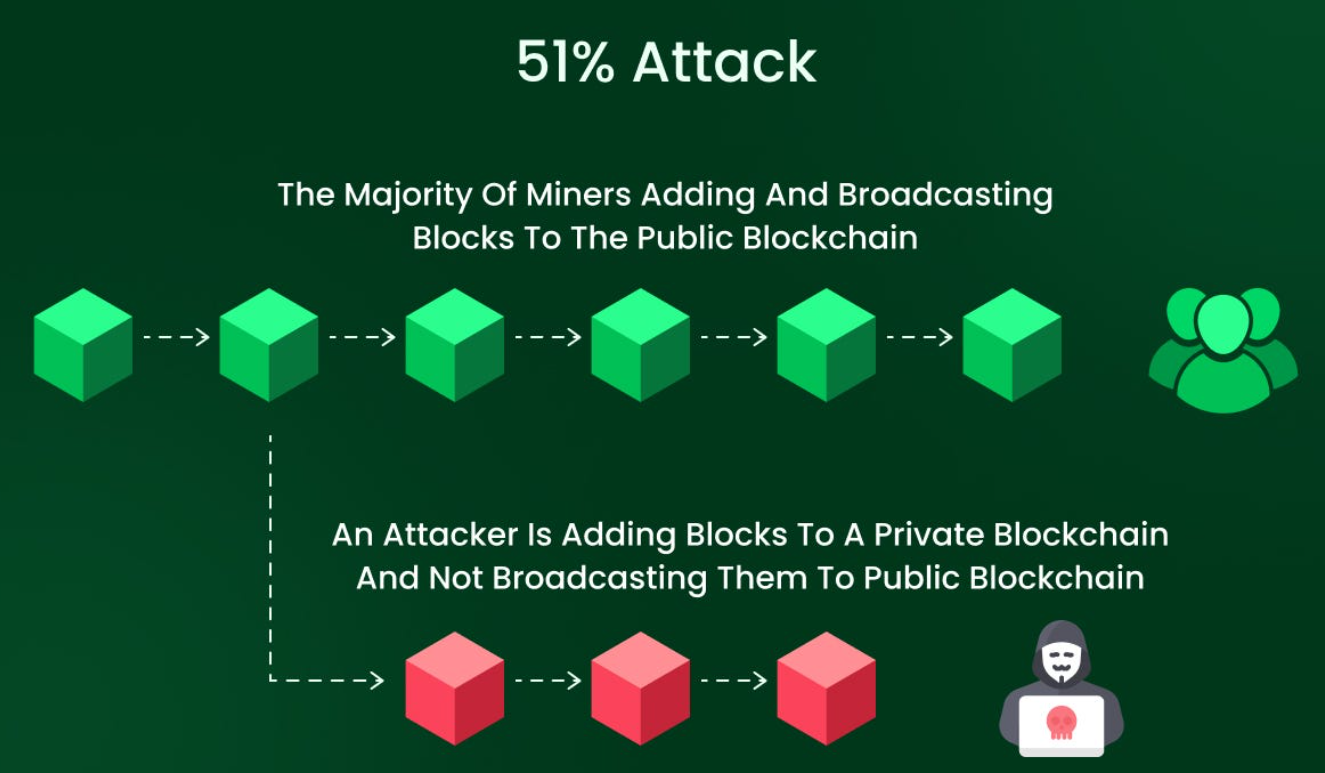
However, in reality, pulling off a 51% attack on Bitcoin is extremely unlikely. The hash rate is spread across thousands of miners worldwide, making it astronomically expensive to gain majority control.
A 2025 study by business professor Campbell Harvey estimates that a week-long 51% attack would cost approximately $6 billion, which includes about $4.6 billion for specialized mining hardware, $1.34 billion for data center construction, and $130 million per week for electricity and operations.
And even if someone managed to do it, the attack would likely crash Bitcoin’s price. I don’t think anyone would want to spend $6 billion to create a new fork just to gain control over Bitcoin that would drop to, say, $20,000.
What happens when the hash rate increases?
When the hash rate rises, it sets off several important changes across the Bitcoin network:
- Stronger network security. More mining power means more protection. As miners add machines, Bitcoin becomes much harder to attack or manipulate. A higher hash rate is like adding extra layers of armor to the network.
- Difficulty increases. When the hash rate rises, Bitcoin automatically increases mining difficulty during the next adjustment. This keeps block times close to the 10-minute target. For miners, it means the puzzles get harder, and they need better hardware to stay in the game.
- More competition for rewards. More miners = more competition. Each miner’s chances of earning a block reward drop unless they upgrade their rigs or lower their electricity costs.
- Higher energy use. More machines working means more electricity is used. This raises miners’ costs and contributes to discussions about Bitcoin’s environmental impact.
- Bullish signal for the market. A rising hash rate often shows growing confidence in Bitcoin. Miners don’t buy new rigs unless they expect long-term returns. Because of that, a higher hash rate is often seen as a sign of institutional interest and overall bullish sentiment.
What happens when the hash rate decreases?
When the hash rate drops, the Bitcoin network doesn’t stop working but a few important things begin to shift:
- Lower security cushion. A decreasing hash rate means fewer miners are contributing power. Bitcoin is still secure and decentralized, but the cost of attempting a theoretical 51% attack becomes lower than during peak activity.
- Difficulty drops. Bitcoin reacts automatically. If blocks start taking longer than usual, the protocol reduces mining difficulty at the next adjustment. Easier puzzles let miners with older or less powerful hardware stay profitable a little longer.
- Short-term profit boost for remaining miners. When some miners leave, those who stay face less competition. Their chances of finding the next block go up until difficulty adjusts again.
- Slower confirmations in the meantime. Between difficulty adjustments, a falling hash rate can temporarily slow block production. That sometimes leads to transaction delays or higher fees.
- Possible market signal. A declining hash rate doesn’t automatically mean disaster, but it can reflect stress in the mining sector like high energy costs or low Bitcoin prices. Investors often view it as a bearish signal, at least in the short term.
What is a good hashrate for Bitcoin mining?
A “good” hash rate depends entirely on your setup, your electricity costs, and the way you mine.
Modern ASIC miners can generate terahashes per second — huge numbers that look impressive on paper. But even with that power, solo miners rarely find blocks consistently. That’s why most miners join pools, where everyone combines their hash rate and earns rewards more steadily.
However, the hash rate value is less important than the profitability behind it. If your electricity bill is higher than the Bitcoin you’re earning, it doesn’t matter how strong your machine is, you’re mining at a loss. If your revenue consistently exceeds your costs, that is a good hash rate for you.
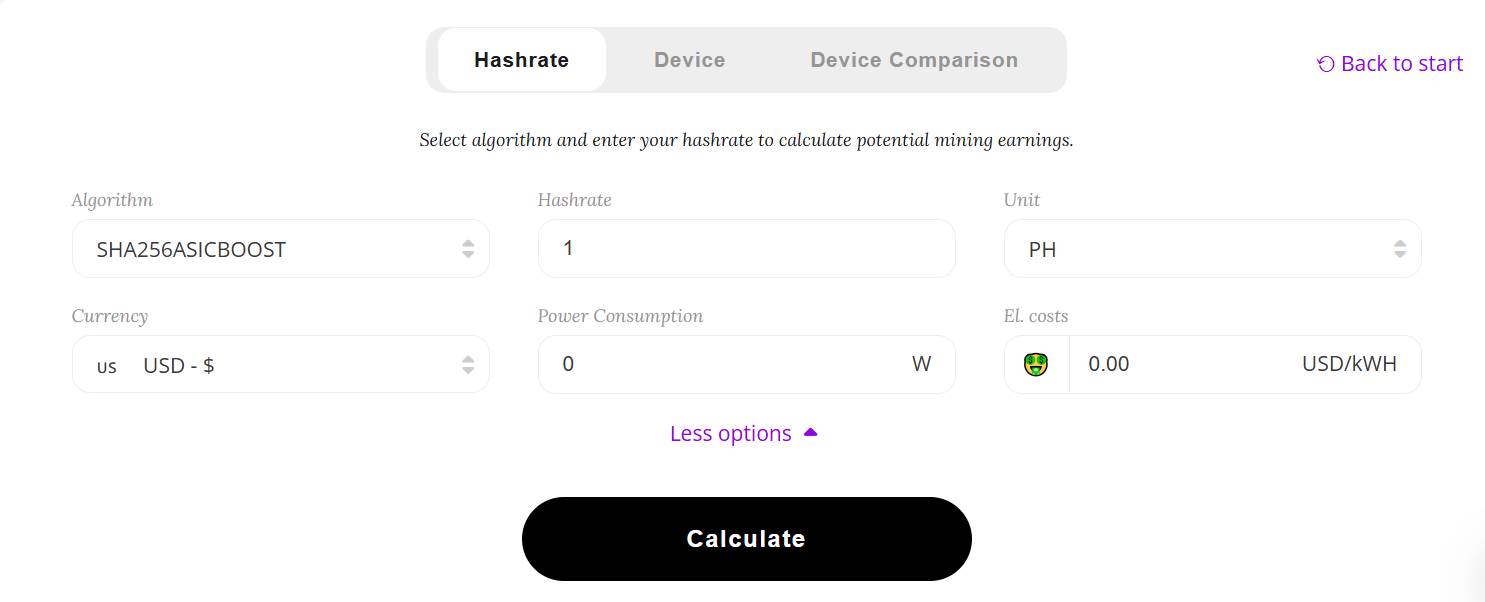
Tracking hash rate: tools and resources
Individual miners track their own hash rate through mining software, while explorers and dashboards publish real-time global estimates. Here are several types of platforms:
Blockchain explorers: Websites like Blockchain.com and Blockchair display current hash rate, difficulty, and other network data. These explorers aggregate information from the Bitcoin blockchain itself and provide comprehensive historical data that allows users to track hash rate trends over time.
Mining pool dashboards: Major mining pools like Antpool, Slush Pool, and F2Pool offer dashboards where miners can monitor their individual hash rate, earnings, and pool-wide statistics. These platforms provide detailed performance metrics.
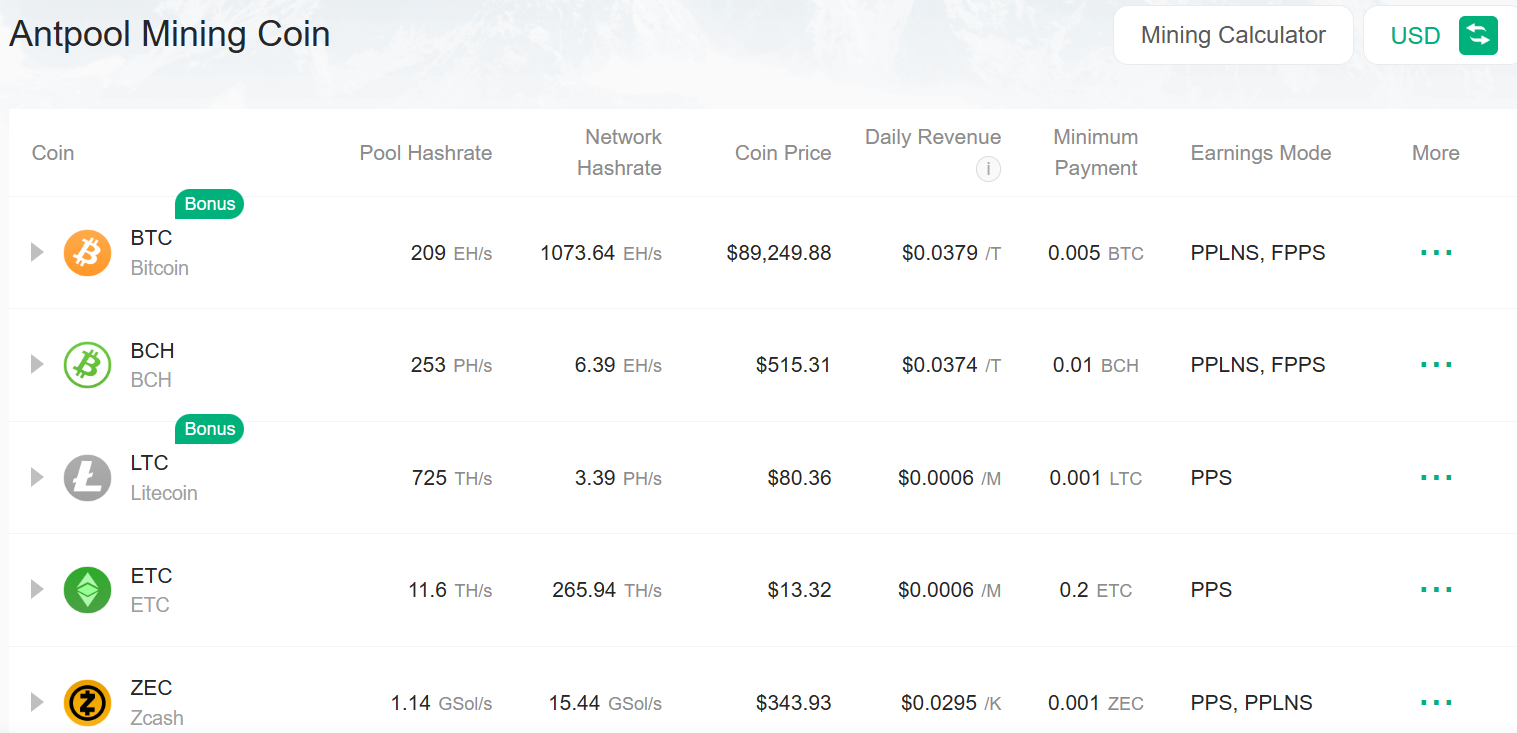
Dedicated analytics platforms: Sites like Coin Warz, Mining Pool Stats, and CryptoCompare specialize in mining metrics and profitability calculations. They display current Bitcoin hash rate, difficulty adjustments, and tools for estimating mining profitability based on hardware and electricity costs.
Bitcoin node software: Running a full Bitcoin node provides direct access to network data. Advanced users can query their node for hash rate and difficulty information using command-line tools.
Mobile apps: Many crypto apps also let you check hash rate on the go, so miners and investors can keep an eye on Bitcoin’s network health right from their phones.
Hash rate converter: It’s a small tool that helps you change one hash rate unit into another. For example, your miner may show speed in TH/s, but a website may display network hash rate in EH/s. These units can be confusing, so the converter simply helps you understand how they compare.
Conclusion
Hash rate is the number of guesses miners make every second trying to solve a new block. For miners, a higher hash rate means more people are mining, competition increases, and they need better equipment to keep up. When the hash rate drops, the miners get a short-term advantage because there are fewer people competing for the rewards.
For investors, it works like a confidence indicator. A high and growing hash rate usually means miners are investing in new hardware and believe Bitcoin’s future is bright.
Most importantly, hash rate reflects Bitcoin’s security. The higher it climbs, the harder and more expensive it becomes to attack the network.
By using hash rate tracking tools, anyone can get a clearer picture of Bitcoin’s overall health and direction.
 Matvii Diadkov
Disclaimer: All materials on this site are for informational purposes only. None of the material should be interpreted as investment advice. Please note that despite the nature of much of the material created and hosted on this website, HODL FM is not a financial reference resource, and the opinions of authors and other contributors are their own and should not be taken as financial advice. If you require advice. HODL FM strongly recommends contacting a qualified industry professional.