






JPMorgan Chase & Co. stated in a new report that the recent heavy selling in the cryptocurrency market may have largely run its course. The bank cited a slowdown in outflows from Bitcoin (BTC) and Ethereum (ETH) exchange-traded funds and improving positioning indicators in the futures market.
According to Nikolaos Panigirtzoglou, an analyst at the bank, investor selling is expected to largely conclude by the end of 2025. The report noted that market liquidity remains strong despite recent volatility.
JPMorgan attributed the latest downturn to risk mitigation measures triggered after MSCI’s October announcement that crypto-related companies could be removed from key equity indices. The bank said this caused temporary forced selling by some funds rather than fundamental weakness in the market.
On January 6, MSCI decided not to exclude crypto-related firms in its global equity index review. JPMorgan said this decision helped stabilize sentiment and reduced the risk of forced sell-offs. The bank added that the move supported expectations for a potential bottom formation.
Bitcoin traded near $94,000 on Tuesday, which shows relative stability after weeks of turbulent trading, as HodlFM reported.
VanEck projects long-term growth for Bitcoin
Another perspective came from investment firm VanEck, which released an updated report on Bitcoin’s long-term capital market assumptions. VanEck projected that BTC could reach $2.9 million per coin by 2050 in a base-case scenario if it captures 5–10% of global trade and 2.5% of central bank balance sheets.
The report was authored by Matthew Sigel, Head of Digital Assets Research, and Patrick Bush, Senior Analyst. VanEck models a 15% compound annual growth rate based on the asset’s expanding institutional adoption.
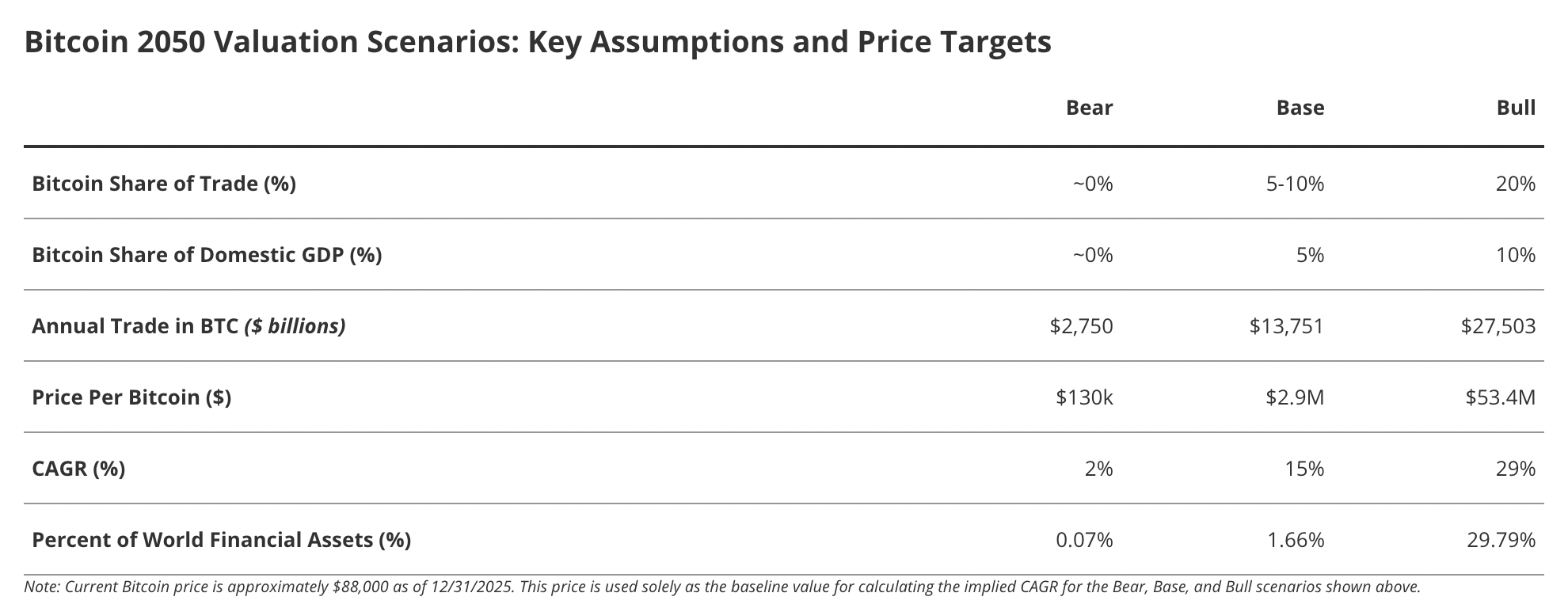
In a conservative scenario, VanEck forecasted Bitcoin at around $130,000 by 2050. Under an optimistic “hyper-bitcoinization” scenario, where BTC achieves 20% of global trade and 10% of domestic GDP, prices could theoretically reach $53.4 million per coin, with a 29% annual growth rate.
“The risk of zero exposure to the most established non-sovereign reserve asset may now exceed the volatility risk of the position itself,” the report stated.
VanEck described Bitcoin’s volatility as comparable to frontier equities, at 40–70%, but emphasized that realized volatility recently fell to multi-year lows near 27%. It also cited BTC’s low correlation with traditional asset classes, which can make it a valuable portfolio diversifier.
The firm’s models suggested that portfolios with a 1–3% allocation to Bitcoin can improve overall efficiency. Historical simulations indicated that a 3% exposure has yielded the best risk-adjusted returns.
At the time of publication, Bitcoin was trading close to $90,000. This shows that short-term volatility is still present, even though institutional views are becoming more positive in the long run.
ETF outflows highlight near-term market caution
Despite improving confidence in long-term fundamentals, short-term investor sentiment remains mixed. U.S. spot Bitcoin ETFs recorded $398.95 million in net outflows on Thursday, which marks their third consecutive day of withdrawals, according to SoSoValue data.
BlackRock’s IBIT fund saw a $193.34 million exit, while Fidelity’s fund logged $120.5 million in outflows. Grayscale and Ark & 21Shares also reported smaller outflows, bringing the three-day total to roughly $1.12 billion.
Spot Ethereum ETFs mirrored the decline, seeing outflows of $159.17 million, led by BlackRock’s ETHA and Grayscale’s ETHE.
“The recent ETF outflows continue to reflect portfolio rebalancing, profit-taking after an initial rally, and short-term caution amid market consolidation rather than a fundamental shift in institutional demand,” said Nick Ruck, Director at LVRG Research.
He added that the market remains in a “resilient consolidation phase,” with Bitcoin holding above $90,000. Ruck warned that traders should monitor ETF flow trends, resistance levels near $95,000, and any policy updates from the Federal Reserve.
 Matvii Diadkov
Editorial disclosure: The publication maintains no financial relationships, sponsorships, or partnerships with JPMorgan Chase, VanEck, BlackRock, LVRG Research, MSCI, or any other firms referenced. The information is drawn from verified materials and public reporting for journalistic purposes only.
Disclaimer: All materials on this site are for informational purposes only. None of the material should be interpreted as investment advice. Please note that despite the nature of much of the material created and hosted on this website, HODL FM is not a financial reference resource, and the opinions of authors and other contributors are their own and should not be taken as financial advice. If you require advice. HODL FM strongly recommends contacting a qualified industry professional.