





Bitcoin’s resilience may face a new kind of test in the coming decade: quantum computing.
Charles Edwards, founder of quantitative Bitcoin and digital asset fund Capriole, has suggested that Bitcoin could fall well below $50,000 by 2028 if the network does not adopt quantum-resistant cryptography.
While much of the discourse has been speculative, some investors and researchers warn that the threat cannot be ignored.
Capriole’s Warning: A Sub-$50K Bitcoin?
Edwards argues that advanced quantum computers could theoretically break current encryption standards, exposing user keys and funds to risk. He stressed that the industry needs to implement solutions as soon as 2026 to avoid a prolonged market downturn.
“If we haven’t deployed a fix by 2028, I expect Bitcoin will be sub $50K and continue to fall until it’s fixed.” “We have to fix this next year, or bon voyage enjoy the biggest Bitcoin bear market in history. FTX will look like a cakewalk” Edwards added.
While some dismiss these concerns as exaggerated, he maintains that Bitcoin could be targeted first because banks and institutions are already migrating to post-quantum encryption, and fraudulent transactions can often be rolled back or blocked in traditional systems.
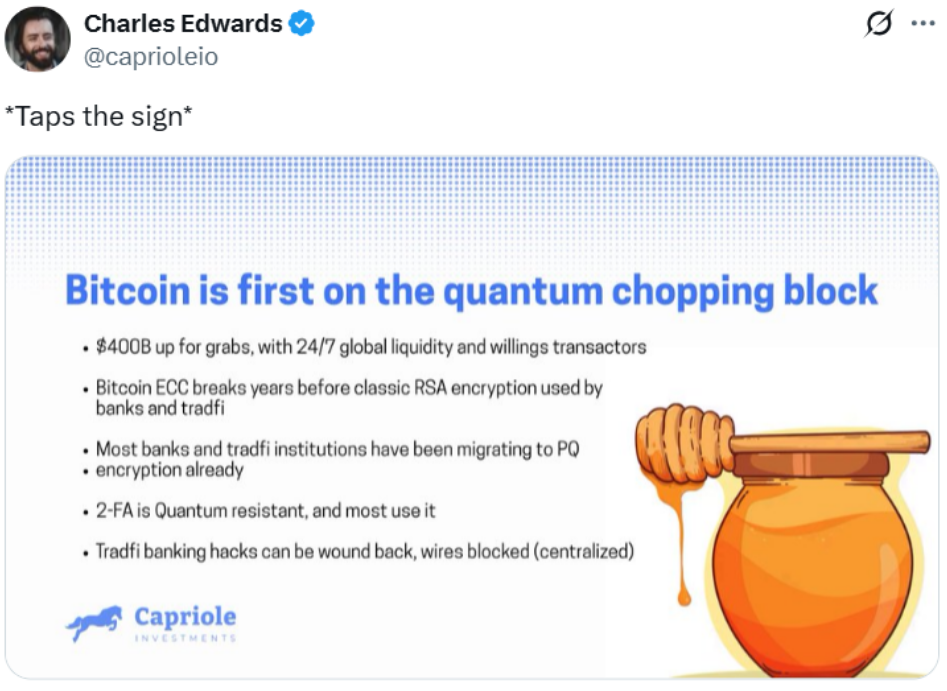
“We have to fix this next year, or bon voyage enjoy the biggest Bitcoin bear market in history. FTX will look like a cakewalk” Edwards added.
Quantum Doom Clock and marketing hype
Meanwhile, quantum countdown websites such as the “Quantum Doom Clock” have projected aggressive timelines for when quantum computers might break public-key cryptography.
These forecasts often compress uncertainty into short-term urgency, sometimes serving as marketing for post-quantum solutions.
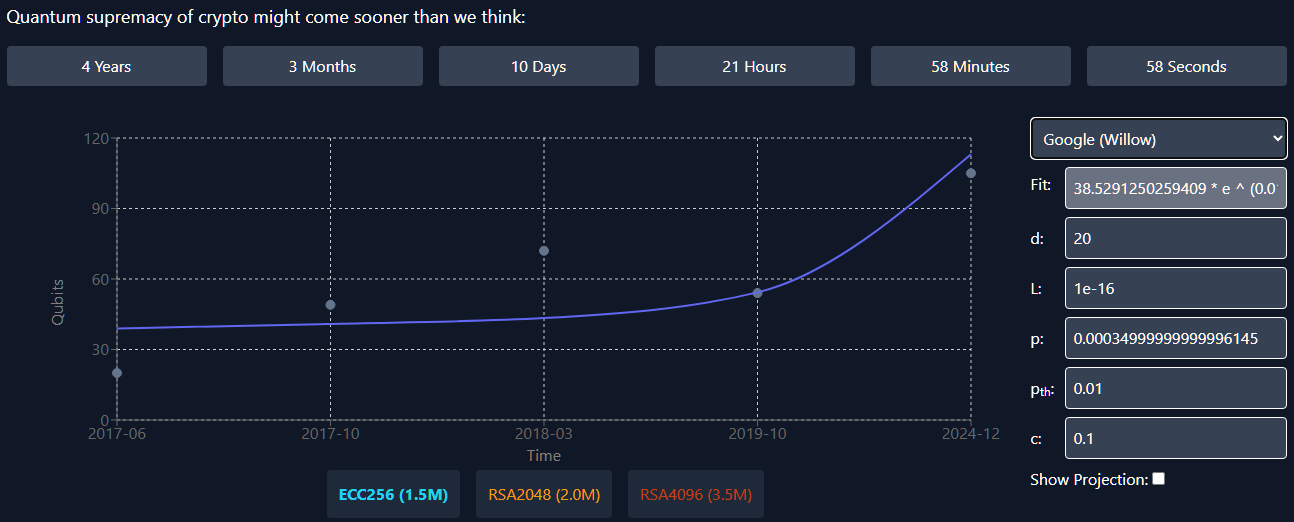
While laboratory progress is real, Caltech has demonstrated a 6,100-qubit neutral-atom array, and Google’s Willow chip shows promising error suppression, most experts caution that practical, large-scale quantum computers capable of breaking Bitcoin’s cryptography are still decades away.
According to the U.S. National Security Agency and the UK National Cyber Security Centre, government systems are targeting post-quantum migration timelines around 2035, not the late 2020s.
Bitcoin’s built-in protections and upgrade path
Even as quantum computers advance, certain Bitcoin outputs remain potentially exposed. Proponents of BIP-360 estimate that over 6 million BTC are held in outputs vulnerable to quantum attacks across legacy P2PK addresses, reused SegWit, and Taproot paths.
“An attack on Bitcoin may not be economically motivated – an attacker may be politically or maliciously motivated and may attempt to destroy value and trust in Bitcoin rather than extract value. There is no way to know in advance how, when, or why an attack may occur. A defensive position must be taken well in advance of any attack.”
This figure represents an upper bound proposed by advocates, not a universally agreed metric. Bitcoin’s design and upgrade paths, including one-time signature schemes and rotation of exposed UTXOs, provide mechanisms to mitigate these risks.

Exchanges and custodians can implement gradual migrations to manage network load and fees, following standards like NIST FIPS-203 and FIPS-204.
Balancing risk and perspective
The conversation around Bitcoin and quantum computing illustrates the difference between marketing-driven urgency and real engineering challenges. While the network should prepare for long-term risks, the immediate threat is limited, and other legacy systems, such as banking infrastructure and online platforms, face equal or greater exposure.
In short, proactive planning and incremental upgrades will likely secure Bitcoin long before a fully capable quantum computer emerges.
 Gunel Ismayilova
Disclaimer: All materials on this site are for informational purposes only. None of the material should be interpreted as investment advice. Please note that despite the nature of much of the material created and hosted on this website, HODL FM is not a financial reference resource, and the opinions of authors and other contributors are their own and should not be taken as financial advice. If you require advice. HODL FM strongly recommends contacting a qualified industry professional.