





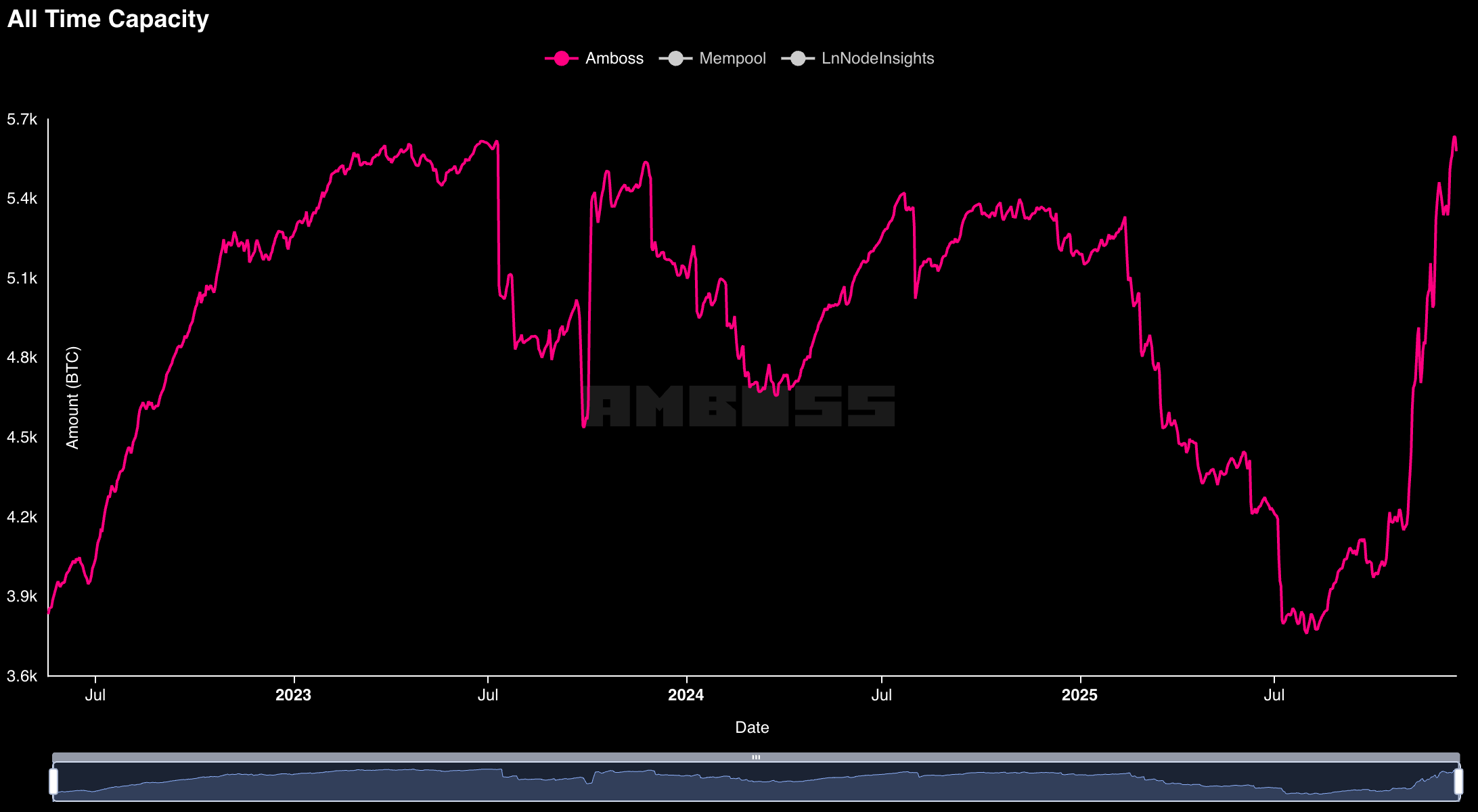
The Bitcoin Lightning Network has hit a new all-time high in capacity as large exchanges and institutions push more liquidity into Bitcoin’s layer-2 payments system. Data from Amboss shows the total capacity at 5,637 BTC, surpassing the previous record set in March 2023. The increase reflects a steady inflow of institutional capital even as grassroots network activity slows.
🚀 Bitcoin Capacity on Lightning hits an All Time High — 5,637 BTC!
— AMBOSS ⚡ (@ambosstech) December 16, 2025
See for yourself: https://t.co/m63VGojrEm pic.twitter.com/McYPHaarSr
Lightning capacity climbs to new record amid changing network dynamics
After more than a year of declining capacity, the Lightning Network’s total Bitcoin held in payment channels began climbing sharply in November and December 2025. Amboss data puts total capacity at 5,637 BTC, valued at around $490 million. The rebound ends months of downtrend and shows that more capital is being concentrated in existing channels rather than distributed across new network participants.
According to Bitcoin Visuals, the Lightning Network operates with nearly 14,940 nodes, compared to its peak of about 20,700 in early 2022. Channel count stands at 48,678, still below its all-time high. The current data suggests that while node and channel numbers have declined, the average liquidity per channel has grown.
This development indicates a network that is becoming more capital-rich but less decentralized in its participation. Amboss attributed the growth to broad inflows from multiple sources rather than any single user or company.
Institutional players drive the latest capacity surge
“It’s not just one company that’s putting more Bitcoin into the Lightning Network; it’s across the board,” said Amboss on its X post, which highlights contributions from Binance and OKX. Both exchanges have integrated Lightning deposits and withdrawals, increasing liquidity available through the network’s channels.
Their participation represents growing institutional interest in Lightning’s potential to facilitate low-fee, instant Bitcoin transactions. These same exchanges had previously been slower to adopt layer-2 functionality, but their renewed focus on Lightning reflects a move toward scalable Bitcoin payments infrastructure.
This institutional involvement contrasts with weaker engagement from smaller node operators and independent users, who have faced cost and technical limitations.
Ecosystem development supports the renewed momentum
Tether, the company behind the world’s largest stablecoin USDT, announced in a press release that it led an $8 million investment round in Speed, a company focused on Lightning-based stablecoin payments. Speed handles over $1.5 billion in annual transaction volume and serves more than a million users across its infrastructure.
The startup’s integration of Lightning technology demonstrates a growing link between stablecoins and Bitcoin’s payments layer. Industry observers view it as Tether’s attempt to expand USDT’s reach beyond Ethereum and into Bitcoin’s ecosystem.
Lightning Labs has also contributed to the renewed momentum by releasing version 0.7 of its Taproot Assets protocol. The upgrade introduces reusable addresses, verified asset supplies, and stronger transaction support. Taproot Assets allows users to issue and move stablecoins directly on Bitcoin while leveraging Lightning’s fast settlement layer.
Announcing Taproot Assets v0.7, now with reusable addresses, a fully auditable asset supply, and larger, more reliable transactions. ✅
— Lightning Labs⚡️🌐 (@lightning) December 16, 2025
With this release, we are laying the foundation for trillions of dollars to flow on bitcoin and Lightning. 💸
Read more below. Upgrade today!
In its statement, Lightning Labs described the update as a base layer for “trillions of dollars to flow on Bitcoin and Lightning.” The firm believes stablecoin functionality will expand Bitcoin’s real-world use cases and enhance its competitiveness with Ethereum-based financial systems.
What the record means for Lightning’s evolution
The Lightning Network continues to serve as Bitcoin’s main scaling architecture, allowing off-chain payments conducted instantly through peer-to-peer channels. These channels rely on pre-signed transactions and cryptographic guarantees to secure the most recent balances without recording every transfer on-chain.
While the technical foundation remains sound, ongoing trends reveal diverging behavior between liquidity providers and everyday users. Higher capacity with fewer active nodes may signal reduced decentralization, but it also improves payment efficiency for those already active on the network.
Developers have designed Lightning to evolve over time through modular upgrades such as Taproot-based channel designs and improved routing protocols. The system can adapt without changing its fundamental goal: direct, trust-minimized BTC payments that bypass high on-chain fees.
Despite lower retail engagement, the latest figures confirm Bitcoin’s Lightning Network is attracting deeper institutional interest. With exchanges, payment processors, and infrastructure companies increasing support, Lightning appears on track to establish itself as a critical component in Bitcoin’s broader payment stack.
The new capacity record represents both confidence in the technology and ongoing shifts in how its liquidity is distributed. Whether this momentum leads to broader adoption or further concentration will depend on how accessible Lightning becomes to smaller users in the years ahead.
 Oleksii Shumak
Disclaimer: All materials on this site are for informational purposes only. None of the material should be interpreted as investment advice. Please note that despite the nature of much of the material created and hosted on this website, HODL FM is not a financial reference resource, and the opinions of authors and other contributors are their own and should not be taken as financial advice. If you require advice. HODL FM strongly recommends contacting a qualified industry professional.