




The BBC confirmed early Saturday that the United States has captured Venezuelan President Nicolás Maduro following coordinated military operations across several Venezuelan states. The event marks a historic geopolitical turning point, but cryptocurrency markets, often sensitive to global shocks, have remained remarkably stable.
Bitcoin and crypto markets stay firm
The early Saturday strikes and subsequent capture of Maduro did not lead to widespread panic. According to CoinGecko, Bitcoin traded above $90,000 and rose 1.5% to reach $91,320. Ethereum and other major tokens also registered modest gains of around 1%. The total cryptocurrency market capitalization increased by 2% to about $3.2 trillion.
Michaël van de Poppe, founder of MN Trading Capital, wrote on X that he does not expect “a widespread correction” tied to the attack. He said the event had already been priced in.
I don't think we'll see a widespread correction based on the attack in Venezuela on #Bitcoin.
— Michaël van de Poppe (@CryptoMichNL) January 3, 2026
It's a planned and coordinated attack on Maduro, and is already past us.
The likelihood of more negativity on the markets from that single event are relatively slim.
I would assume…
Data from CoinGlass shows about $60 million in Bitcoin positions were liquidated over a 24-hour span, with short traders contributing roughly $55 million of that amount. Past conflicts prompted sharper instant declines, but this time the reaction stayed subdued.
Comparisons to past geopolitical shocks
In June 2025, Bitcoin fell nearly 3% within 90 minutes after explosions in Tehran. Those moves happened when panic about prolonged instability grew. The latest event unfolded differently, because the U.S. operation appeared swift and targeted.
Lennaert Snyder, a crypto market analyst, expressed caution that volatility could increase when equity and commodity markets reopen. He wrote on X that “there’s a lot of geopolitical tension,” adding that “we’ll probably see more volatility on Bitcoin after the weekend.”
$BTC has entered the weekend range.
— Lennaert Snyder (@LennaertSnyder) January 3, 2026
We all know weekend ranges are choppy and slow, so I'm waiting until I get a trigger at the boundaries.
The ~$90,930 high is interesting for shorts after confirmation if we get the liquidity sweep. If we show strength and gain it, longs could… pic.twitter.com/KuTLDgk8uK
The Economic Times reported that geopolitics “has muscled its way back into markets at the very start of 2026,” with senior digital producer Riya Sharma writing that the situation may “set up potential turbulence across crude oil, precious metals, currencies, and equities when trading resumes on Monday.”
Oil price swings and U.S. control of Venezuela’s energy
Oil markets whipsawed on Monday after news of Maduro’s capture. Investing.com reported Brent crude at $60.81 a barrel and West Texas Intermediate at $57.44 early in the day. Prices briefly rebounded after an initial drop to their lowest level since early 2021.
U.S. President Donald Trump said Washington would oversee Venezuela “until a new leader is elected.” The move could increase global supply if U.S. firms gain access to Venezuelan production, but rebuilding infrastructure will take time.
Ben Emons, founder of Fed Watch Advisors, said in a note that more Venezuelan output could cause U.S. gasoline prices to fall, a development that might help Trump’s political standing in the months ahead. Warren Patterson at ING said a “smooth transition” could lift the blockade on sanctioned tankers, while a “messier transition” could temporarily erase up to 900,000 barrels per day of supply.
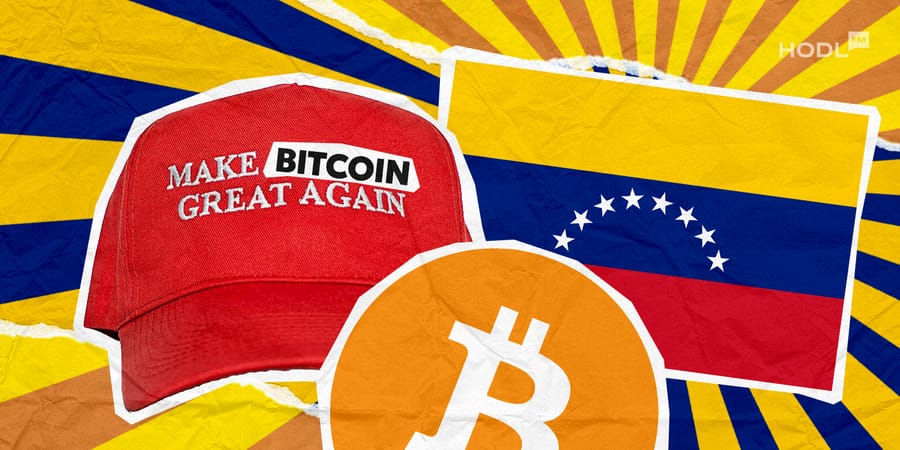
Bitcoin as a symbol in Venezuela’s uncertain future
With Maduro now detained in New York on drug trafficking and corruption charges, political eyes have turned to possible new leadership in Caracas. Opposition figure and Nobel Peace Prize winner María Corina Machado has become a key contender, according to prediction market platform Kalshi.
Machado told the Human Rights Foundation’s Alex Gladstein in 2024 that “Venezuelans found a lifeline in Bitcoin during hyperinflation.” She said it evolved “from a humanitarian tool to a vital means of resistance,” adding that she looked forward to “embracing it in a new democratic Venezuela.”
Her prospects remain uncertain after U.S. President Trump said she “doesn’t have the support within or the respect within the country.”
Broader implications for crypto and sanctions
Venezuela’s reliance on crypto predates these events. Years of sanctions pushed citizens and businesses toward digital assets, with stablecoins such as USDT becoming common for daily transactions. Ari Redbord of TRM Labs said the absence of references to crypto in Maduro’s indictment reflects a prosecutorial focus on narcotics rather than any judgment that crypto plays no role.
He added that after military actions, “things move faster and become more fragile,” as networks turn to alternative methods of payment. Those conditions, he said, make market behavior “more volatile” but also more adaptive.
The overlap of high-level politics, energy policy, and digital money has again placed Bitcoin’s resilience in focus. Despite the unpredictability of the world, the token's stability over the weekend suggested that cryptocurrency's role may be developing globally.
 Gunel Ismayilova
Disclaimer: All materials on this site are for informational purposes only. None of the material should be interpreted as investment advice. Please note that despite the nature of much of the material created and hosted on this website, HODL FM is not a financial reference resource, and the opinions of authors and other contributors are their own and should not be taken as financial advice. If you require advice. HODL FM strongly recommends contacting a qualified industry professional.