






Bitcoin fell sharply Monday evening, extending recent losses as investors shifted away from risky assets and stock indices retreated. The drop pushed Bitcoin below $86,000, erasing gains from early December and adding to pressure across the crypto market.
Bitcoin falls alongside equities
According to TradingView data, Bitcoin dropped 4.4% in the past 24 hours to $85,617 as of 11:30 p.m. ET on Monday. Ether fell 6.5% to $2,915, while BNB, XRP, and Solana lost between 4% and 7%.
Rick Maeda, research associate at Presto Research, said there was no specific crypto-related factor that triggered the move. Rather, the slide mirrored weakness in risk assets after the stock market opened lower.
“Liquidity has been thinning into year-end, which tends to exaggerate moves, particularly during U.S. trading hours,” Maeda said.
Vincent Liu, CIO of Kronos Research, provided a similar view, describing a rapid shift to “risk-off” positioning as macroeconomic jitters resurfaced.
“Traders rotated into safer assets,” Liu said. “The Fed cut barely moved the needle against a cautious outlook, and with leverage unwinding and year-end liquidity drying up, selling cascaded into a sharper drop.”
Last week, the Federal Reserve cut interest rates by 25 basis points, marking its third reduction this year. Analysts expected this cut to inject optimism into risk markets, but sentiment has remained muted as caution increases ahead of key inflation data due later this week.
Mining disruptions in China add pressure
Part of the negative sentiment also stemmed from a large-scale crypto mining shutdown in China’s Xinjiang region.
On X, crypto trader NoLimit pointed to the halt of as many as 400,000 mining rigs, an estimate confirmed by Jianping Kong, chairman of Nano Labs and a former co-chair of Canaan’s board. Kong stated the shutdown caused a drop of roughly 100 exahashes per second, about 8% of the Bitcoin network’s total hashrate from the previous day.
Kong also wrote over the weekend that “crypto mining farms in Xinjiang were shutting down machines one after another.” China recently renewed its crackdown on digital assets, with its central bank pledging to “severely crack down on illegal and criminal activities.”
Min Jung, research associate at Presto Research, said the country’s enforcement revealed how fragile the mining rebound had been.
“This comes after China’s mining share had quietly rebounded into the mid-teens in recent months, largely driven by cheap power and excess data-center capacity in western provinces,” Jung said. “The speed of enforcement shows that this rebound was always fragile and dependent on staying out of public view.”
However, Jung clarified that analysts have not found clear evidence that miners sold significant amounts of Bitcoin during the recent drop.
Liu of Kronos added that while the mining halt could weigh on Bitcoin’s hashrate temporarily, any resulting sell pressure would likely be short-lived, noting that “fundamentals remain intact.”
Profit-taking and investor rotation
Data from CryptoQuant indicated that some of the sell pressure came from new large investors, or “whales,” who accumulated more than 1,000 BTC during the past five months. Unrealized losses for these entities have now reached the deepest levels since 2023.
Long-term holders, meanwhile, remain largely profitable despite the price decline. The data also shows a trend of Bitcoin rotating from long-term holders to newer investors, suggesting profit-taking rather than panic selling.
Shivam Thakral, CEO of BuyUCoin, said:
“New whales going underwater don’t automatically imply forced selling. Capitulation risk rises if Bitcoin loses key cost-basis levels for recent buyers, especially around ETF or institutional entry zones.”
Market outlook
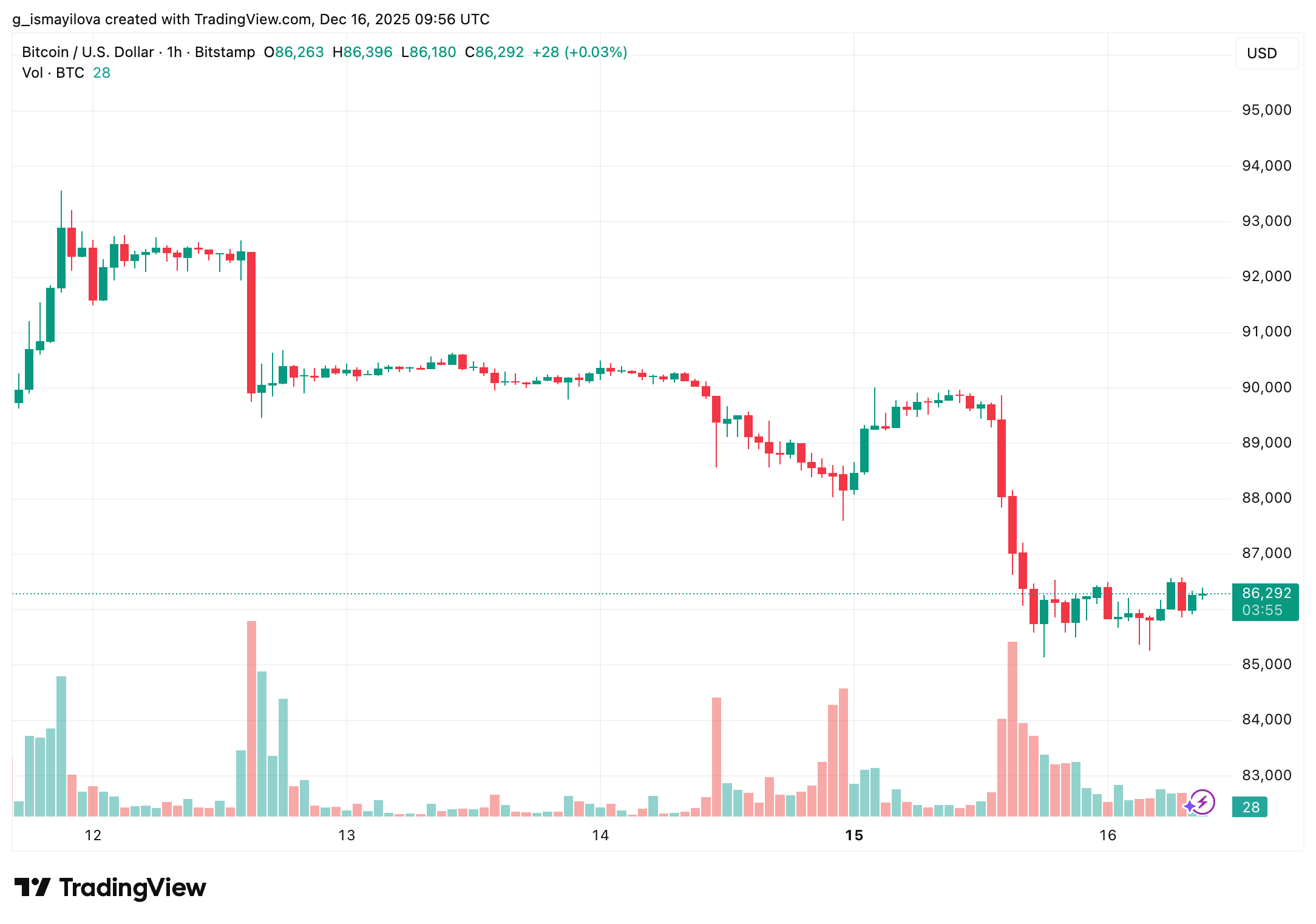
With the $84,000 support level under pressure, technical analysts expect volatility to persist. If Bitcoin loses this level, prices could slide toward the $72,000–$70,000 region before potential stabilization.
The broader Crypto Fear and Greed Index stands at 11, indicating “Extreme Fear” among investors. Market analyst Kadan Stadelmann said that “Bitcoin could fall as low as $75,000” in the near term but warned that sentiment remains overly fearful.
Despite the uncertainty, buy orders concentrated between $80,000 and $85,000 could provide a temporary floor, limiting downside moves, according to crypto analyst Ted Pillows.
$BTC has large buy orders between $80,000 and $85,000 on Binance.
— Ted (@TedPillows) December 15, 2025
This could act as a strong support for Bitcoin. pic.twitter.com/L1MrOJk3cS
 Tanya Petrusenko
Disclaimer: All materials on this site are for informational purposes only. None of the material should be interpreted as investment advice. Please note that despite the nature of much of the material created and hosted on this website, HODL FM is not a financial reference resource, and the opinions of authors and other contributors are their own and should not be taken as financial advice. If you require advice. HODL FM strongly recommends contacting a qualified industry professional.